
CASE NOTES
Plant poisonings of sheep in summer rainfall, non-temperate, eastern Australia
Shaun Slattery, Local Land Services, Narrabri
This paper was initially presented at the 2022 Sheep, Camelid and Goat Veterinarians Conference, Adelaide June 2022
Posted Flock & Herd March 2023
Introduction
Plant poisonings of sheep are a major animal health and management problem in the cropping and pastoral summer rainfall parts of eastern Australia. For the purposes of this paper the author defines this area as the NSW plains and lower slopes north of Dubbo and the non-temperate sheep areas of Queensland.
In this paper, the author draws on his 30 years' experience as a District Veterinarian in north-west NSW and the observations of colleagues to describe the current field presentation, key clinical signs, key diagnostic tools, case management and prevention of plant poisonings in this part of Australia.
Many of the poisonings seen in this region are very sporadic, not being seen for years or decades, only to return with poisonings in multiple flocks when the necessary circumstances occur. This pattern of occurrence often creates a loss of corporate knowledge between poisoning years, both in the regional farming community and the veterinarians that serve them. This paper attempts to address this challenge.
The toxic principles and pathology of plant poisonings are not addressed as these are generally well addressed in the veterinary literature.
The paper aims to include plant poisonings of sheep that have been reported in the region in recent decades. This list was determined by the following process. Firstly, all plant poisonings in John Plant's vade mecum1 were listed. Poisonings were then included if any of the follow applied: they had been investigated by the author or the author knew directly of confirmed cases in the region, such as Ross McKenzie's Toxicology for Australian veterinarians2 including a report of poisoning in the region, and a credible report in Hurst's The Poisonous Plants of New South Wales3; or colleagues consulted by the author reported they had seen cases.
This paper does have a weakness in that only colleagues with primarily NSW experience were consulted, relying on the literature to confirm poisonings that are limited to Queensland.
The poisonings are listed in alphabetical order, generally on genus name.
A list of plant poisonings not reported by the above process, despite the plant growing in the region, is at the end of the paper. This further emphasises that plant poisonings require multiple factors for poisoning to occur, not just the presence of the plant.
The notes for each plant poisoning were then developed using the experiences of the author and consulted colleagues (if no direct author experience noted in section heading), information in Mckenzie2, Hurst3, Chris Bourke's guide for differentiating nervous and muscular locomotor disorders of sheep4 and case reports in the literature and on the District Veterinarians' of New South Wales Flock and Herd case notes website5.
Hypocalcaemia in ewes on grazing fodder oats (Avena sativa)
- Circumstances of poisoning
- Introduction of ewes in the last month of pregnancy to lush, rapidly growing fodder oats pasture. More likely if lime/salt licks have not been provided.
- Clinical signs
- Sternal recumbency, hind legs extending behind in a 'frog-leg' attitude, tremors.
- Key diagnostic tools
- History and clinical signs. Response to treatment. Reduced pupillary reflex. Low blood calcium is a variable diagnostic tool.
- Case management
- Calcium, Magnesium and Glucose injections.
- Prevention
- Avoid introducing late pregnancy ewes to risk crops. Provide lime/magnesium oxide/salt licks.
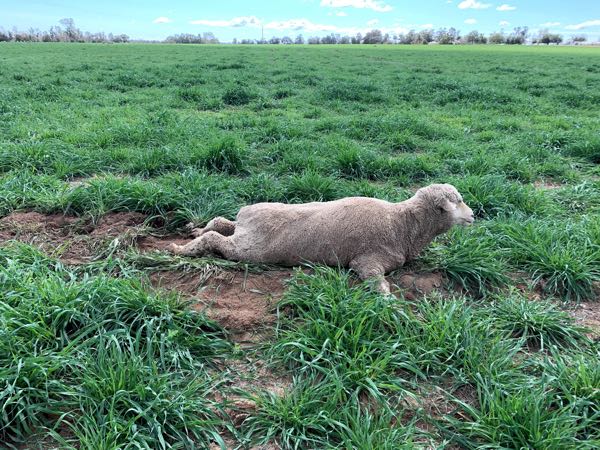
Ewe showing classical 'frog-legs' from hypocalcaemia
Photosensitisation in lambs grazing fodder oats (Avena sativa)
- Circumstances of poisoning
- Unpigmented lambs. Typically well growing, heavily fertilised, lush crops. Cases often seen after a few sunny days following a period of several cold and overcast days.
- Clinical signs
- Photosensitisation. Drooping of oedematous ears, especially when viewed from back of mob. Lesions of vulva on docked sheep often may be used to differentiate photosensitisation from other causes of face swelling.
- Key diagnostic tools
- History and clinical signs.
- Case management
- Remove from oats. Provide as much shade as possible (wool shed superior to shaded paddock), non-green feed. Pasture often safe within a few days. Do a trial run with small number from the mob.
- Prevention
- Awareness with prompt action if cases observed.
Blue-green algae (cyanobacteria)
- Circumstances of poisoning
- Blue-green algae bloom producing a surface scum that is blown by wind and concentrated on a shoreline where sheep drink. While blue-green algae blooms are relatively common, livestock poisonings are uncommon.
- Clinical Signs
- Sudden death, jaundice, ill thrift, photosensitisation, blue-green stains on mouth and legs.
- Key diagnostic tools
- History, liver - gross and histopathology, identification of toxic species in water and scum samples.
- Case management
- Remove access to water, supportive including shade, providing non-green feed.
- Prevention
- Awareness and avoiding circumstances of poisoning.
Despite confirming several cases in cattle, the author has not investigated any confirmed cases of sheep. Other regional colleagues confirm this pattern. In contrast to reports in southern areas of Australia, a search of the literature found only one report of poisoning in sheep in the region, near Gilgandra in 19666. This minimal incidence of poisoning in northern sheep may be due to climatic factors, and / or a reflection that in this zone, sheep are regularly watered from sources that are unlikely to be affected by blue-green algae (troughs and dams supplied by windmills and artesian bores, including pipe and trough schemes).
Rock Fern (Cheilanthes sieberi) - polioencephalomalacia
- Circumstances of poisoning
- Usually when naïve sheep are exposed to pastures where C. sieberi is the only green feed. Classical circumstance is dry winters with dry stands of summer grasses with C. sieberi growing through it, with a small amount of rain sufficient to produce suddenly abundant green C. sieberi but no pasture green. Introduced, weaner and hoggets at most risk.
- Clinical Signs
- Blindness, reduced awareness and 'star-gazing' stance, progressing to lateral recumbency and paddling, may be nystagmus.
- Key diagnostic tools
- History and clinical signs, response to thiamine, histopathology brain (may be false negative).
- Case management
- Treat with thiamine (usually good response), remove from pasture, corticosteroids may also assist.
- Prevention
- Awareness and avoiding circumstances of poisoning.

Typical dry standing feed winter paddock growing containing green Cheilanthes underneath

Green and attractive Cheilanthes in above paddock leading to sheep poisoning
Ellangowan poison bush (Eremophila deserti) poisoning
- Circumstances of poisoning
- Historically, travelling hungry stock placed in paddocks where E. deserti only available feed. Recent investigations are sporadic, low prevalence mortality where sheep have consumed E. deserti during winters when other pasture is short.
- Clinical signs
- Maybe found dead, photosensitisation and jaundice in mild cases, nervous signs.
- Key diagnostic tools
- Grazed shrubs present. Gross and liver histopathology.
- Case management
- Removal of mob from paddock. Affected cases placed in woolshed (darkness) with no green feed.
- Prevention
- Awareness and prompt actions if poisoning occurs.
Fuchsia Bush (Eremophila maculata) cyanogenic glycosides poisoning
- Circumstances of poisoning
- Consumption of new shoots after dry period when E. maculata has shed most of it leaves. Can occur with sheep already grazing paddock. E. maculata can occur in stands of a dozen plus plants causing 10-20 deaths. Sheep die near plants.
- Clinical signs
- Dead sheep near plants. Sheep with respiratory distress may recover.
- Key diagnostic tools
- History. Plant parts in rumen. Exclusion of other causes of sudden death.
- Case management
- Affected cases usually recover quickly if received non-lethal dose. Remove sheep from E. maculata until shoots harden. Fencing off stands an option, especially coming out of drought.
- Prevention
- Awareness, checking E. maculata for dangerous growth and exclude sheep.
Flood plain staggers (author no direct experience with sheep)7
- Circumstances of poisoning
- Pastures dominated by Agrostis avenacea (blown or blow away grass). In the 1990-91 outbreak cases were associated with autumn and winter flooding in 1990 and two previous years of wet winters and dry summers (opposite to usual pattern). Cases began in spring. Sheep cases occur later in outbreak than cattle.
- Clinical signs
- Convulsive episodes, wide-based stance, ataxia, and hypermetria of the forelimbs and sometimes, less severely, of the pelvic limbs.
- Key diagnostic tools
- History, clinical signs, presence of toxic galls in A. avenacea inflorescences.
- Case management
- Remove sheep to safe pastures. Shade, water, and minimal disturbance. A few cases and deaths will continue to occur.
- Prevention
- Awareness. As soon as cases seen in cattle in district, remove sheep to safe pastures.
Heliotrope (Heliotropium europaeum) poisoning (author no direct experience, consulted colleague)8
- Circumstances of poisoning
- Reported from the southern part of the region, usually lambs, grazing stubble with thick covering of H. europaeum with no other feed. Acute hepatopathy after a few weeks to months of grazing.
- Clinical signs
- Weight loss over weeks, less commonly photosensitisation.
- Case management
- Remove from pasture. Any sheep with photosensitisation place in shed and provide non-green feed.
- Prevention
- Awareness of risk pastures and avoid grazing.
Humpy back9
- Circumstances of poisoning
- Full-woolled adult sheep being mustered distances in hot and often humid conditions, classically for shearing during heat waves. Usually low prevalence within mob.
- Clinical signs
- Not present when sheep first disturbed. Requires an extended period of driving (usually over one kilometre). Affected sheep lag behind mob with increasingly short and stilted gait, almost walking on the spot. Affected sheep then lower their head, bringing their hind legs forward and arching their back (humpy back) before collapsing. After brief rest (few minutes to twenty minutes) the sheep rise again to follow the flock. Problem recurs within shorter distance. Sheep will die if forced to make repeated attempts to walk. Elevated rectal temperatures.
- Key diagnostic tools
- History, hyperthermia, recovery with removal of wool and exclusion of other causes.
- Case management
- Affected sheep picked up urgently and transported to yards for shearing as soon as possible, shade and water. Picking up sheep at first recumbency critical. These sheep generally recover. Sheep that have multiple recumbencies have a significantly poorer prognosis.
- Prevention
- Minimise mustering in high-risk conditions. Make shorter staged movements. Muster sheep in the early morning. Sufficient staff for pick-up vehicle with mob.
Author believes this is not primarily a toxicity but rather hyperthermia due to mustering in hot conditions in full wool. The hyperthermia may be accentuated by other minor aliments or toxicities such as respiratory disease, marginal hypocalcaemia due to oxalates etc. Increasing reports in recent years may be due to use of motorised vehicles for mustering and increasing sheep size and fleece weight.
Flat Billy Button, Leiocarpa brevicompta (Ixiolaena brevicompta) poisoning (author no direct experience)10
- Circumstances of poisoning
- Locally dense stands may occur on the flood plains of the Darling River and its tributaries following flooding. Poisoning occurs when sheep are constrained to graze mature plants with intact seed heads over summer for more than 14 days. Mustering sheep precipitates clinical signs. Younger sheep more affected.
- Clinical signs
- On mustering, affected sheep show exercise intolerance, recumbency, weakness and sudden death.
- Key diagnostic tools
- History, clinical signs and gross pathology and histopathology.
- Prevention
- Awareness of risk of dense local stands following flooding. Removal of stands at green stage by cropping or intensive grazing. Restricting grazing of mature plants to less than 14 days.
Marshmallow Staggers (Malva parviflora)11
- Circumstances of poisoning
- Two classic circumstances. Firstly, weaner sheep held in yards containing abundant growth of M. parviflora. On release, or if trucked from yards on arrival, weaners show classic staggers syndrome. Relatively common in wet winters. Second circumstance in severe years with ewes and lambs grazing pastures with extensive stands of M. parviflora. Lambs at foot are classically affected as yarded for marking, weaning etc. with possible extensive losses at marking due to exercise stress and mismothering. Occasional adult sheep are also affected. In 2021, M. parviflora grew through winter until late spring with sheep readily consuming the seeds. As a result, weaners grazing pastures were also affected when mustered. Some weaner mobs took several weeks to recover after removal from M. parviflora pastures. Historically severe years occur with the break of major droughts in the autumn.
- Clinical signs
- In weaners and adult sheep, after walking a short distance, take increasingly short steps, before arching their backs and collapsing. After a short period, rise and walk short distance before repeating. Repeated attempts will lead to death. Tremors and knuckling seen in severe cases. In young lambs mustered with their ewes, sternal recumbency, refusal to move and generalised muscle fasciculations.
- Key diagnostic tools
- History and clinical signs. Histopathology of myocardium and limb muscles. May need multiple samples of myocardium and animals.
- Case management
- Awareness of risk pastures and have vehicles and staff available to pick up affected sheep at first recumbency. These sheep generally recover. Sheep that have multiple recumbencies have a significantly poorer prognosis.
- Prevention
- Remove M. parviflora from yards (mow or whipper-snip, graze other stock) prior to yarding with at-risk animals. Awareness of risk pastures and manage risk with shorter staged movements, staff and vehicles to pick up recumbent sheep, moving to safe paddock for a couple weeks before marking.

Paddock south of Walgett, October 2020, containing dried M. parviflora plants and seeds, causing Marshmallow Staggers
Nardoo (Marsilea drummondii) poisoning12-13
- Circumstances of poisoning
- While M. drummondii is a frequent part of many floodplain pastures in the region, inhabiting drains, gilgais and other shallow depressions, poisonings are relatively uncommon. Mass poisonings of sheep grazing M. drummondii-dominated pastures on floodplains have been recorded. However, poisonings are generally limited to circumstances where some factor attracts the sheep to the M. drummondii. These include during drought conditions when rain is sufficient to produce M. drummondii growth in depressions without other pasture growth and when paddocks are sown to fodder crops leaving unsown low patches containing areas of M. drummondii. Sporadic cases can also been seen in mobs grazing M. drummondii-dominated paddocks.
- Clinical signs
- Blindness, reduced awareness and 'star-gazing' stance progressing to lateral recumbency and paddling, may be nystagmus.
- Key diagnostic tools
- History and clinical signs, response to thiamine, histopathology brain (may be false negative).
- Case management
- Treat with thiamine (usually good response), remove from pasture, corticosteroids may also assist.
- Prevention
- Awareness and prompt action when cases occur.

Gilgais in the Narrabri district containing attractive growth M. drummondii during dry conditions, leading to poisoning
Photosensitisation grazing burr medic (Medicago polymorpha)
- Circumstances of poisoning
- Lambs grazing abundant stands of lush M. polymorpha. Usually requires good winter rains after dry summers that have reduced ground cover. Generally, cases occurring throughout district. Aphids present in most but not all toxic pastures.
- Clinical signs
- Photosensitisation. Drooping of oedematous ears, especially when viewed from back of mob. Lesions on vulva of docked sheep often useful to differentiate photosensitisation from other causes of face swelling.
- Key diagnostic tools
- History and clinical signs.
- Case management
- Remove from pasture. Provide as much shade as possible (wool shed superior to treed paddock), non-green feed. May be extended period until pasture safe. Use small number test mob.
- Prevention
- Awareness with prompt action if cases occur.
Photosensitisation grazing lucerne (Medicago sativa)
- Circumstances of poisoning
- Classically young sheep grazing well-growing, well-managed stands. May have been grazing for extended period. Aphids may or may not be present.
- Clinical signs
- Photosensitisation. Drooping of oedematous ears, especially when viewed from back of mob. Lesions on vulva of docked sheep often useful to differentiate photosensitisation from other causes of face swelling.
- Key diagnostic tools
- History and clinical signs.
- Case management
- Remove from lucerne. Provide as much shade as possible (woolshed superior to treed paddock), non-green feed. Pasture often safe within 10 days. Use small number test mob.
- Prevention
- Awareness with prompt action if cases occur.

Lamb photosensitisation on grazing lucerne with drooping of oedematous ears

Lamb with photosensitisation on grazing lucerne showing vulvar lesions
Mycotoxin poisoning associated with feeding grain or plant material14
- Circumstances of poisoning
- Author's experience suggests sheep are very resistant to mycotoxin poisoning from contaminated cereal grains (feeding of mouldy grain common in droughts). Cases with cereals are generally limited to sheep consuming solid caked mouldy grain residue from cleaned-out silos or sheep given access to the caked exterior of grain piles stored long term in the open. Drought feeding of mould-contaminated peanuts or other alternative feeds is higher risk.
- Clinical signs
- Dependent on toxin, inappetence at next feeding (drought).
- Key diagnostic tools
- Gross pathology and histopathology, feed assay.
- Case management
- Cease feeding, supportive including shade, easy access to water.
- Prevention
- Avoid caked mouldy grain from cleaned-out silos, dilute mould-contaminated cereals with clean sources, feed to most resistant class of stock, avoid or test non-cereals with mould.
Nitrate-nitrite poisoning
- Circumstances of poisoning
- Specific circumstances are required for sheep to eat large amounts of high-nitrate plant material in a short period of time. High-nitrate plant material is classically from post-dry period growth in high nitrogen soils in yards and holding yards. After the 2017-20 drought there had also been sufficient absence of growth, and presumedly nitrogen fixing, for pasture paddocks to also produce high nitrate plants. Hungry and empty sheep are essential and often the result of trucking (and then unloading in yards with high-nitrate plants) or yarding for management procedures. The longer off feed the greater the risk. Particular plants seem to be easily and quickly consumed by sheep. These include pigweed (Portulaca spp.) in yards and paddocks, and marshmallow (M. parviflora) in yards, especially with breaks that occur in winter months.
- Clinical signs
- Mostly sudden deaths. Affected sheep show rapid respiration and ataxia, either dying or recovering to walk away within 30 minutes of severe signs.
- Key diagnostic tools
- Nitrate-Nitrite test strips on eye fluid.
- Case management
- Rarely encounter live cases.
- Prevention
- Awareness. For trucked sheep, remove risk plants from yards by cutting and removing. For yarded sheep, supply good quality forage to fill before allowing access to paddocks. If early in outbreak remove from pasture or yards.
A wide variety of plants are potential nitrate accumulators, however in this region, and the author's experience, most cases are due to pigweed (Portulaca spp.) and marshmallow (M. parviflora).

M. parviflora in yards following consumption by yarded sheep and nitrate-nitrite deaths. Growth resulted from rains after a dry period.

Ewes north of Lightning Ridge, killed by nitrate-nitrite poisoning from lush Portulaca spp. growing after the breaking of the 2017-20 drought. Ewes had been yarded for crutching and released back to paddock.
Poisoning of lambs grazing Bambatsi panic (Panicum coloratum) pasture
- Circumstances of poisoning
- Lambs preferentially grazing actively growing new shoots following rain. May be either short pasture regrowth or shoots from the base of mature clumps.
- Clinical signs
- Photosensitisation (possibly severe), jaundice, initial cases signalled by shade-seeking in overcast or cool weather.
- Key diagnostic tools
- History, gross pathology and histopathology on liver.
- Case management
- Remove from pasture. Provide as much shade as possible (woolshed superior to treed paddock), non-green feed. See prevention for return to pasture.
- Prevention
- Only graze lambs on mature pastures that are not actively growing. Remove sheep from the pasture following rainfall. Initially graze actively growing pasture with ewes to remove green shoots. Delay grazing lambs until 2-3 weeks after any rain. Graze lambs at high stock densities to reduce the potential for lambs to preferentially graze any new green shoots.

Mature stand Bambatsi panic where poisoning occurred following consumption new shoots at base of clumps. Wee Waa, March 2018.

Lamb at display stage showing jaundice after poisoning on mature Bambatsi panic.

Lamb jaundice of eyes after poisoning on mature Bambatsi panic.
Poisoning in lambs on Panicum effusum (hairy panic) (author no direct experience)15
- Circumstances of poisoning
- Reported from southern part of region. Lambs grazing pasture dominated by Panicum with green shoots, either from short growth or lower shoots in mature plants. Often in fallow cultivation paddocks.
- Clinical signs
- Photosensitisation, possible severe, jaundice, initial cases signalled by shade-seeking in overcast and cool weather.
- Key diagnostic tools
- History, gross pathology and histopathology of liver.
- Case management
- Remove from pasture. Provide as much shade as possible (woolshed superior to treed paddock), non-green feed. See prevention for return to pasture.
- Prevention
- Only graze lambs on mature pastures that are not actively growing. Remove sheep from the pasture following rainfall. Initially graze actively growing pasture with ewes to remove green shoots. Delay grazing lambs until 2-3 weeks after any rain. Graze lambs at high densities to reduce the potential for lambs to preferentially graze any new green shoots.
Acute oxalate poisoning with pigweed (Portulaca spp.)
- Circumstances of poisoning
- Sheep moved from pastures with no or little Portulaca, held off feed so hungry, and moved to pasture dominated by lush Portulaca. Classical risk pastures are often holding paddocks around yards that were bare following a dry summer, and that following late summer-autumn rains now contain abundant lush Portulaca. Cases can occur both in mobs grazing the Portulaca pasture (usually found within 12 hours) or only when the mob is moved within 48 hours.
- Clinical signs
- Initial sternal recumbency, hind legs extending behind in 'frog-leg' attitude, tremors. Can quickly progress to lateral recumbency and death. On moving, exercise intolerant followed by sternal recumbency and 'frog-leg' attitude.
- Key diagnostic tools
- History and clinical signs. Response to treatment (can be immediate). Reduced pupillary reflex. Low blood calcium, but variable.
- Case management
- Calcium, magnesium and glucose injections.
- Prevention
- Awareness and avoiding risk circumstances.
While kidneys with evidence of oxalate damage are a not uncommon incidental finding to investigations into other causes of death, the author has not seen clinical chronic oxalate poisoning.
Wild Turnip (Rapistrum rugosum) poisoning
- Circumstances of poisoning
- Cases are limited to specific circumstances where hungry sheep are suddenly given access to lush and rapidly growing stands of R. rugosum at the rosette stage. Paddock shifts, holding in yards and historically release from overnight Travelling Stock Route breaks are common situations. R. rugosum-risk pastures occur when dry summers and autumns have reduced ground cover and late autumn-winter rains produce R. rugosum germination and growth.
- Clinical Signs
- Blindness, reduced awareness and 'star-gazing' stance progressing to lateral recumbency and paddling, maybe nystagmus.
- Key diagnostic tools
- History and clinical signs, response to thiamine (even though sulphur associated), histopathology brain (may be false negative).
- Case management
- Treat with thiamine (usually good response). As the sudden access is a trigger removal from pasture is not essential, corticosteroids may also assist.
- Prevention
- Awareness and avoiding circumstances of poisoning, especially sudden access while hungry.

R. rugosum at rosette stage typically associated with poisoning, in this case in cattle
Rumen impaction from feeding high-oil drought feeds
- Circumstances of poisoning
- High-level feeding of high-oil drought feeds (nuts, palm kernel) with low digestibility roughage feed (straw etc.). Sporadic deaths after day or so of standing away from mob. Often the better condition sheep. May be triggered by change in roughage, feeding regime.
- Clinical signs
- Affected sheep often found recumbent and or dead. Difficult to differentiate from shy feeders.
- Key diagnostic tools
- Gross pathology of dry, impacted rumen.
- Case management
- Cease feeding high-oil feed, increase grain and pellets feeding, ensure roughage less than 20% diet.
- Prevention
- Ensure ration oil content less than 6%.

Ewe with an impacted rumen from feeding walnuts and oaten straw with no other available paddock feed.
Acute cyanogenic glycoside poisoning grazing forage and grain sorghums
- Circumstances of poisoning
- Requires both sorghum with high cyanogenic glycoside levels and hungry sheep able to consume large amounts of sorghum quickly. With modern varieties of forage sorghum, poisonings in actively growing, even re-growth crops are rare. Poisonings generally occur in crops that have been extensively grazed to stubble, with some short regrowth that is moisture stressed or frosted.
- Clinical signs
- Mostly found dead. Affected sheep show rapid respiration and ataxia, either dying or recovering to walk away within 30 minutes of initial severe signs.
- Key diagnostic tools
- History and exclusion of other causes. Testing of plant material.
- Case management
- Rarely encounter live cases.
- Prevention
- Don't graze risk stages. Avoid introducing hungry stock to sorghum paddocks, including accidental access. Hay feeding before introduction, use small test mob.

Moisture stressed perennial silk sorghum leading to acute cyanogenic glycoside poisoning, in this case in cattle
Sorghum-associated ataxia (author no direct experience)16
- Circumstances of poisoning
- Extended grazing of forage sorghums with elevated cyanogenic glycoside levels. Typically crops grown in droughts with just sufficient rain to produce occasional new shoots.
- Clinical signs
- Weakness, ataxia, head shaking, knuckling of fetlocks, inability to rise, and opisthotonos.
- Key diagnostic tools
- History, clinical signs and brain and spinal cord histopathology.
- Case management
- Remove from pasture. Provide feed and water to affected cases until recover, may take several months for full recovery.
- Prevention
- Avoid grazing risk pastures. Supplement with sulphur while grazing.
Trachymene (Wild Parsnip) - Bentleg (author no direct experience)17
- Circumstances of poisoning
- Late summer or autumn rains following drought producing Trachymene. Preferential grazing of flowers with seeds in early summer by pregnant or lactating ewes. Suitable circumstances for district-wide outbreaks limited to every 10-15 years.
- Clinical signs
- Lambs with front legs bowed.
- Key diagnostic tools
- History and clinical signs.
- Case management
- Proportion of lambs fully recover.
- Prevention
- Awareness and avoiding circumstances of poisoning.

Lamb with bentleg. Glendambo district, South Australia. Courtesy Nigel Baum South Australia Department of Primary Industries & Regions
Photosensitisation from Tribulus spp18
- Circumstances of poisoning
- Tribulus does not generally cause this poisoning when lush and rapidly growing. In the author's experience, cases have been associated with sufficient rain for initial germination and growth of a carpet of Tribulus, but low soil moisture then produces wilted and stressed plants. Young sheep are more susceptible.
- Clinical signs
- Photosensitisation (possibly severe), jaundice, initial cases signalled by shade seeking in overcast and cool weather.
- Key diagnostic tools
- History, gross pathology and histopathology liver.
- Case management
- Remove from pasture. Provide as much shade as possible (woolshed superior to treed paddock), non-green feed. Pasture may be toxic until rain produces new growth. Use small number test mob.
- Prevention
- Awareness with prompt action if cases observed.

Wilted Tribulus-dominated pasture causing poisoning. Wee Waa, January 1994.
Coonabarabran staggers (Tribulus terrestris)- cat-head, caltrops19-21
- Circumstances of poisoning
- Summer rains after drought or on fallow paddocks, producing T. terrestris-dominated pastures. Cases appear at least three months after initial exposure and may continue to appear months after removal from T. terrestris. Meat-breed sheep and their crosses significantly more susceptible. Usually low prevalence (<3%). Clinical course lasts average eight months. Usually adults, but occasionally hoggets may be affected. Note T. terrestris fruit has segments that form a typical caltrop long spiked form. T. micrococcus has globular fruit without long spikes.
- Clinical signs
- Chronic, progressive, and irreversible. Initial mild hindquarter paresis. Next asymmetry develops with one hind limb showing more weakness. This pattern results in affected sheep moving sideways from the hindquarters as they run. In the final stages, forelimb weakness develops leading to recumbency and death.
- Key diagnostic tools
- History and asymmetrical hindlimb ataxia.
- Case management
- No treatment. Consider euthanising affected sheep. Remove mob from T. terrestris pastures.
- Prevention
- Avoid grazing T. terrestris-dominated pastures, especially fallow paddocks.

Ewes with Coonabarabran staggers demonstrating asymmetrical hindlimb paresis by leaning into each other. West of Moree, November 2020.
Yellow-vine staggers (Tribulus micrococcus)22
- Circumstances of poisoning
- Early autumn rains after drought, with follow-up falls, producing T. micrococcus-dominated pastures. Cases appear 3-5 weeks later in adults. Meat-breed sheep and their crosses significantly more susceptible. Usually low prevalence (<3%). Deaths occur due to secondary issues such as flystrike, pregnancy toxaemia, and misadventure. Otherwise affected sheep recover a few weeks after removal from pasture or when T. micrococcus no longer dominates the pasture. Note T. micrococcus has globular fruit without long spikes, unlike T.terestris.
- Clinical Signs
- Bilaterally symmetrical, transient, hindlimb ataxia.
- Key diagnostic tools
- History and clinical signs.
- Case management
- Remove mob from pasture. Carry affected sheep to yards to ensure watering, feed and shelter.
- Prevention
- Avoid grazing meat breeds and cross-bred adult sheep on T. micrococcus-dominated pastures.

Crossbred ewe with symmetrical paresis after grazing T. micrococcus-dominated pastures. Wee Waa
Swainsonia (Darling Pea) poisoning (author no direct experience, consulted colleague)23
- Circumstances of poisoning
- Large number of historical records in northern NSW but few in recent decades. Recent reports after the 2013 Coonabarabran fires when timing of fires and rains produced regrowth pastures that were dominated by Swainsonia. Poisoning occurs where sheep eat Swainsonia as large proportion of diet for over four weeks. Noted in literature as occurring after summer droughts and floods with winter rain. Smallholding or house paddocks feature in recent goat reports.
- Clinical signs
- Difficulty in mustering due to failure of mob behaviour an early sign, ataxia, tremor, hyperexcitability and weight loss (sheep may progress to emaciation and death without nervous signs).
- Key diagnostic tools
- History, clinical signs and histopathology.
- Case management
- Removal from pasture leads to gradual recovery unless severe.
- Prevention
- Avoid grazing risk pastures for more than four weeks.

Swainsonia growing in near pure stands after 2013 Coonabarabran fires leading to sheep poisoning. Courtesy Judy Ellem, District Veterinarian, Local Land Services
Crown beard (Verbesina encelioides) poisoning (author no direct experience, consulted colleague)24
- Circumstances of poisoning
- Hungry sheep where V. encelioides-only feed or only green feed. Large number of historical records in northern NSW but few in recent decades, despite V. encelioides stands under tress being common in the region. Recent case reported in southern part of region.
- Clinical Signs
- Rapid death, respiratory difficulty.
- Key diagnostic tools
- History, gross pathology.
- Case management
- Remove from access.
- Prevention
- Awareness, avoid circumstances.
Bloat from faba bean (Vicia faba)25
- Circumstances of poisoning
- Generally dorper lambs or weaners givenad lib. access to faba beans, especially after period off feed.
- Clinical signs
- Death, bloat.
- Key diagnostic tools
- History, gross pathology reveals rumen foam and forequarters congestion.
- Case management
- Rarely opportunity to treat within critical period. As per pasture bloat, oral oils etc.
- Prevention
- Limit feeding of beans including introductory ration and ensure self-feeders not faulty. Generally large amount of consumption required for poisoning.

Stable foam bloat in dorper weaners givenad lib access to faba beans. Courtesy Libby Guest, District Veterinarian, Livestock Health and Pest Authority (NSW)
Plants that occur in region but no recent reports of poisoning in literature
-
- Copper poisoning from chronic pyrrolizidine alkaloidosis, Nerium oleander, Mother of Millions - (Bryophyllum spp.) despite grazing pastures poisoning cattle.
- Cycad, Green Cestrum (Cestrum parqui) - despite grazing pastures poisoning cattle.
- Gossypol toxicity despite extensive feeding of lambing ewe mobs with white cottonseed.
- Ipomoea poisoning, Noogoora Burr (Xanthium chinense), facial eczema (cases seen in cattle grazing oats).
- Nitrate-Nitrite from sorghum hay (fed same hay sources poisoning cattle).
- Stagger weed (Stachys arvensis), Stypandra glauca, Solanum spp.
Acknowledgements
I would like to acknowledge the assistance of Megan Davies, Steve Eastwood, Judy Ellem, Jillian Kelly, Greg McCann and Bob McKinnon in providing input on regional poisonings initially omitted and the key elements of poisonings, especially those outside the author's experience.
References
- Plant J. Diagnosis of diseases of sheep. University of Sydney Post-Graduate Foundation in Veterinary Science, 1992
- McKenzie RA. Toxicology for Australian veterinarians. RA McKenzie, 2002
- Hurst E. The poison plants of New South Wales. Compiled under direction of the Poison Plants Committee of New South Wales. 1942
- Bourke CA. The clinical differentiation of nervous and muscular locomotor disorders of sheep in Australia. Australian Veterinary Journal, 1995 Jun;72(6):228-34. Available from: doi.org
- Flock and Herd, Case notes on veterinary investigations in sheep, cattle and other species [Internet]. [Place unknown]: Association of District Veterinarians of New South Wales; [cited 9 May 2022]. Available from: http://www.flockandherd.net.au
- McBarron EJ, May V. Poisoning of sheep in New South Wales by the blue-green alga Anacystis cyanea (Kuetz.) Dr. and Dail. Australian Veterinary Journal. 1966 Dec;42(12):449-53. Available from: doi.org
- Davis EO, Curran GE, Hetherington WT, Norris DA, Wise GA, Roth IJ, Seawright AA and Bryden WL. Clinical, pathological and epidemiological aspects of flood plain staggers, a corynetoxicosis of livestock grazing Agrostis avenacea. Australian Veterinary Journal. 1995 May 1;72(5):187-90. Available from: doi.org
- Salmon D. Pyrrolizidine alkaloid poisoning of sheep. Flock and Herd March 2012. [cited 9 May 2022]; Available from: www.flockandherd.net.au
- Pratap B. T Humpy Back in Sheep [webinar]. Queensland: Leading Sheep; 7 March 2017 [cited 9 May 2022]. Available from: www.leadingsheep.com.au
- Walker K. Ixiolaena brevicompta intoxication in sheep post-flooding and its control by environmental and grazing management. 1991 13-17 May, Darling Harbour, Australia; Australian Veterinary Association, 2009. Available from: www.ava.com.au
- Kelly J. Small flowered mallow (marshmallow, Malva parviflora) intoxication (marshmallow staggers) in the Coonamble district following drought-breaking rain. Flock and Herd February 2021. [cited 9 May 2022]. Available from: www.flockandherd.net.au
- Slattery S. Unusual presentations of Cheilanthes sieberi and Marsilea drummondii poisonings in the Narrabri RLPB district. Flock and Herd 2005. [cited 9 May 2022]; Available from: www.flockandherd.net.au
- Chick BF, Eggleston GW, McCleary MB. The Epidemiology of Nardoo Poisoning in Sheep. The Association of Veterinary Inspectors of NSW, 62nd Annual Conference; 1979 April 2-6; Sydney. Place of publication: Assoc of Veterinary Inspectors of NSW; 1979. [cited 9 May 2022] p. 55-60. Available from: www.flockandherd.net.au
- Davies M. Mycotoxicosis in a merino flock. Flock and Herd February 2015. [cited 9 May 2022]; Available from: www.flockandherd.net.au
- Litchfield NH. Yellow big-head in lambs. Institute of Inspectors of Stock of N.S.W. Year Book 1948 Annual Conference; 1948 March 15-19; Sydney, Australia : [cited 9 May 2022]. p. 75. Available from: www.flockandherd.net.au
- Davies M. Sorghum-associated neuroaxonal degeneration in dorper lambs. Flock and Herd December 2018. [cited 9 May 2022]; Available from: www.flockandherd.net.au
- Clark L, Carlisle CH and Beasley PS. Observations on the pathology of bent leg of lambs in South-Western Queensland. Australian Veterinary Journal 1975 Jan 1;51(1):4-10. Available from: doi.org
- McCann G. Crystal associated cholangiopathy (yellow big head) in lambs grazing Tribulus terrestris. Flock and Herd July 2013. [cited 9 May 2022]; Available from: www.flockandherd.net.au
- Bourke CA. Staggers in sheep associated with the ingestion of Tribulus terrestris. Australian Veterinary Journal 1984 Nov;61(11):360-3. Available from: doi.org
- Eastwood S. Tribulus staggers. Flock and Herd February 2011. [cited 9 May 2022]; Available from: www.flockandherd.net.au
- Maher S. Tribulus terrestris staggers in the Coonabarabran area. Flock and Herd December 2019. [cited 9 May 2022]; Available from: www.flockandherd.net.au
- Bourke CA, Macfarlane JA. A transient ataxia of sheep associated with the ingestion of Tribulus micrococcus (yellow vine). Australian Veterinary Journal 1985 Aug 1;62(8):282. Available from: doi.org
- Irwin T. Neurological cases in ruminants. Flock and Herd September 2010. [cited 9 May 2022]; Available from: www.flockandherd.net.au
- McCann G. Crownbeard toxicity. Proceedings of the Australian Sheep Veterinarians Annual Conference. The Australian Veterinary Association Proceedings of the 7th World Congress on Medical Informatics. 2012 Sep; Barossa Valley, South Australia; 2012. Available from: www.ava.com.au
- Morrice G. Faba bean bloat in weaned lambs. Flock and Herd October 2010. [cited 9 May 2022]; Available from: www.flockandherd.net.au