
ARCHIVE FILE
This article was published in 1945
See the original document
INSTITUTE OF INSPECTORS OF STOCK OF N.S.W. YEAR BOOK.
NITRITE POISONING
A "Smash" in Travelling Sheep.
K. S. F. Bray, B.V.Sc., Inspector of Stock, Hay.
Summary: Until quite recent times spectacular mortality in stock, particularly hungry sheep freshly introduced on to succulent feed, has been ascribed to various causes; among which poisoning by weeds has been common. Account is given of such a mortality, predisposition to which resulted from infestation with various worms, such as Ostertagia sp. (brown; hair; stomach), Nematodirus (thin necked; red; bowel), and Trichostrongylus sp. (black-scour; bowel).
The sheep, untrucked at Carrathool early in July, 1942, were poor, cold and empty, and losses estimated at 12% occurred within 24 hours; mostly due, apparently, to Nitrite poisoning. The plants which were the sources of the poison were Cryptostemma Sp. (Capeweed), Plantago (Lamb's Tongue) and Medicago Spp. (Trefoils); the former, apparently, being mainly responsible. In no case was rumenal Tympanites (Bloat) present; nor was gorging permitted by the drover.
The knowledge gained resulted in losses being kept at a relatively very low level in a trainload of similar sheep which untrucked at the same centre two days later.
History: Both lots of sheep, numbering 5,291 and 5,390 respectively, had been subject to similar conditions. They were moderately to heavily infested with the worms described above and had had a good deal of walking, prior to trucking, through cold, wet lanes in another district, where very little feed was available. This combination of factors was responsible for deaths in both mobs prior to trucking. The first mob arrived with 48 dead in the trucks, while 30 died in the yards immediately after untrucking. Such losses continued on 1/7/42 as the mob was moved with difficulty; first over rather bare country with scanty growth of Plantago and Medicago species, improving as higher, red country covered with a thick, short growth of C. calendulaceae (Capeweed) was approached.
Great increase in mortality occurred during the afternoon and night of the next day, and at 10 am. on 3/7/42, of a mob of just over 5,000, comprising roughly half young wethers and half weaners, some 500—mainly young sheep—were dead, with a few dying, after having travelled only two miles. The writer was compelled by an impassably wet road to travel late at night to the Carrathool bridge to cross to a better road; and access to the bridge was almost cut off by the carcases of hundreds of dead and dying sheep. There was nothing significant noticed among those dying, and there was no evidence of bloat.
Autopsy: The appearance of all dead sheep was very similar. Tympanites was absent, but a small quantity of blood-stained froth and watery stomach content had discharged from the mouth and nose. Most of the heads of the dead animals were held well back with the noses pointing skywards in a characteristic attitude. Internally there was little to see other than a typical picture of worm infestation. There was a very heavy infestation with Nematodirus and Trichostrongylus in the small bowel; Ostertagia being less numerous in the fourth stomach. Emaciation was marked, and the rumens examined contained relatively small, watery masses of Capeweed. The heart sacs were distended moderately with a clear, straw-coloured fluid which showed little tendency to clot.
Laboratory examination revealed that the calcium and magnesium levels in the blood were within the normal range (10.3 and 2.5 milligrammes per cent). The stomach content gave a positive reaction for nitrates when cold and, on incubation, a very strong positive reaction for both nitrates and nitrites. (Note—non-poisonous nitrates, so common in certain plants, can be converted by ferments in the heated paunch of an animal into very poisonous nitrites).
Conclusions: Starvation, exposure, worm infestation and nitrite poisoning undoubtedly all contributed towards this mortality. The more important role of the nitrites in causing the "smash" was exemplified by the fact that losses in the first mob eased down to the typical "few a day," so common in worm infestation, as soon as the effect of the nitrites had subsided.
After waking a very worried drover on the first night of the investigation he was advised to avoid a short, thick growth of Capeweed carpeting a red rise, and support to the theory that this plant was mainly responsible for the trouble was lent by subsequent events. Another train-load, similar in most respects and arriving on 3/7/42, sustained 7 deaths in trucks, 61 in the yards, and only 21 during the day's feeding on the PlantagoM/i> and Medicago species alone; the Capeweed being avoided. Thereafter losses in this mob were merely a few each day, as in the first consignment.
Explanatory Note: Constructive criticism of a previous article in this publication was made by an interested stock and station agent, who holds a degree from the University of Sydney. He said that he had difficulty in understanding many of the scientific terms so commonly used by Veterinarians; and that this was undesirable as, apparently, such articles were written for the enlightenment of stockowners, among others. It is considered that such criticism was timely; and consequently endeavour has been made now to use terms which, while readily understood by progressive landholders, should not mislead or bore other persons. At the same time it is hoped that stockowners will note that scientific terms are not always as complicated as lay ones.
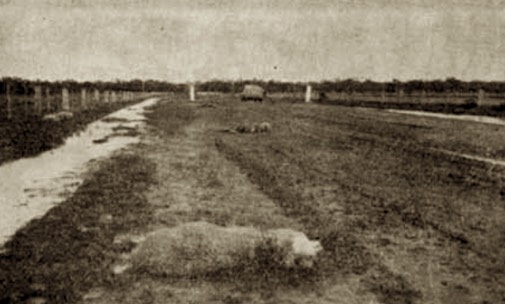
A general view of section of the smash.
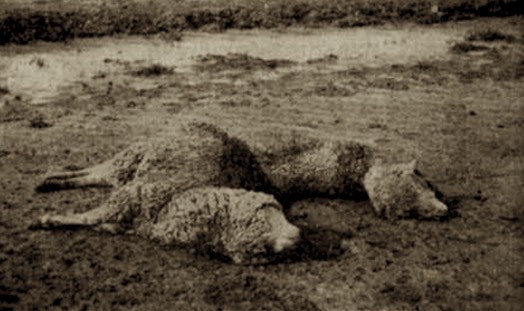
Characteristic attitude after death.