
CASE NOTES
Lightning strike deaths and neurological signs in cattle
Jess Cooke and Bruce Watt, District Veterinarians, Central Tablelands Local Land Services
Posted Flock and Herd March 2026
INTRODUCTION
Lightning strike is an occasional cause of sudden death in livestock, and in survivors can cause neurological impairment and burns. As animals tend to cluster under trees or along fences, multiple deaths have been reported (Suddes and Neef 2007, Watt 2012 and Shankar and Braddon 2015).
Animals dying from lightning strike may show profuse bleeding from the nose, eyes and mouth and may show linear or arboreal singe marks on the hair, often on the legs (Parkinson et al. 2019, Watt 2017).
HISTORY
In late November 2024, the first author was called to investigate multiple cattle deaths, with surviving cattle showing signs of neurological disease, in the Central Tablelands of New South Wales.
The affected mob consisted of approximately 88 mixed-age mature Angus cows with three-month-old calves at foot. They were grazing across two paddocks. The first had a very high proportion of phalaris (Phalaris aquatica) and short mixed annual grasses (vulpia (Vulpia bromoides) and soft brome (Bromus hordeaceus)), occasional white (Trifolium repens) and sub clover (Trifolium subterraneum) and the weed species cat's ear (Hypochaeris radicata) and saffron thistles (Carthamnus lanatus). The annual grasses were running to head with 50% green matter. Water was supplied by a tank to troughs in the first paddock, and the second paddock had a dam that had no signs of blue-green algae. There were no feed or mineral supplements supplied.
Cows had been vaccinated approximately every three months with 7-in-1 (to cover clostridial diseases plus Leptospires Hardjo and Pomona) and annually against pestivirus (Pestigard®, Zoetis). A long-acting selenium injection (Selovin, barium selenate, Elanco) was given annually.
The cows had been moved into the first paddock on 14 November 2024. The trough was not working at that point, and it is believed that the cows broke through the fence into the second paddock shortly after being put in the first paddock. There were no illnesses or deaths noted around that time.
The deaths were noticed early on the morning of 29 November. The initial report was of 15 dead cows and another 15-20 with neurological signs. The carcasses were reported to be reasonably fresh.
The evening before there had been a storm and a lot of lightning. It was assumed by the producer that the deaths were due to lightning strike.
CLINICAL EXAMINATION
An initial property visit was conducted by the first author on 29 November 2024. The neurological signs in the 15-20 affected cows ranged in severity. Some were alert, would approach humans and stand to be patted. Some became aggressive. Their gait was slow and tentative with shortened strides. One was noted to be pacing up and down a fenceline.Some animals were recumbent, exhibiting fine muscle tremors. Some were in lateral recumbency and repeatedly paddling all limbs. Vision appeared to be intact. One animal examined relatively closely was able to move and retract her tongue normally. There were no singe marks or other dermal lesions noted on the live animals at the time of examination.
Some animals appeared to have died extremely rapidly. They were in lateral recumbency with no scuff marks around the feet and head. Other cows had died caught up in tree forks or fallen branches. The deaths were not localised in one area, or around trees or fences, but spread over approximately 1 Ha.
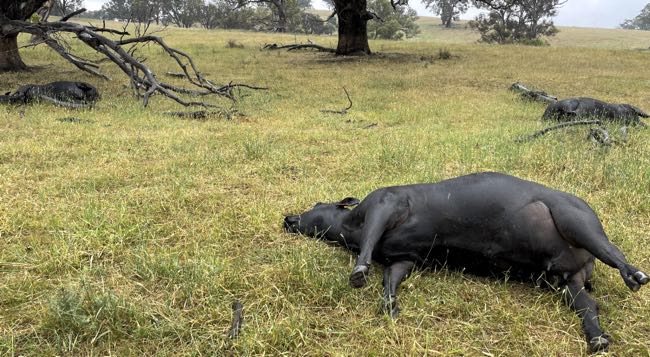
Figure 1. Cows found dead (in situ). They appear to have died suddenly.
NECROPSY FINDINGS
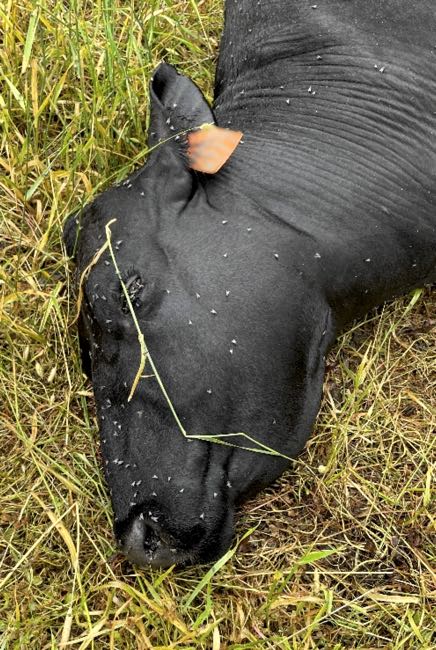
Figure 2. One of the dead cows with traces of a bloody nasal discharge
Three anthrax ICTs were performed on bloody fluid samples from three carcasses. All returned negative results. Despite close examination, there were no singe marks or any other dermal abnormalities noted.
Blood samples were collected from two live animals.
Two moribund cows were selected for post-mortem and euthanised by captive bolt. Post-mortem examinations showed mild congestion of the lung in one animal (Figure 3) but were otherwise unremarkable. No dermal lesions or singe marks were noted.
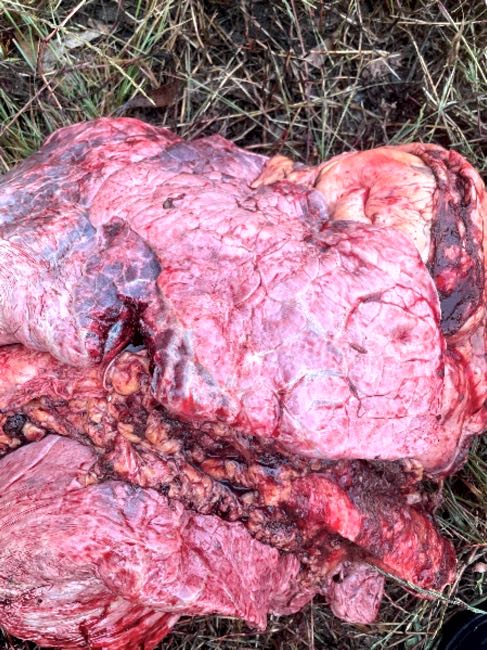
Figure 3. Lungs showing mild congestion
Due to ongoing inclement weather, three heads were collected and the brains later removed.
The brains had slight brown discolouration rostrally and this area also appeared to be shrunken (Figure 4).
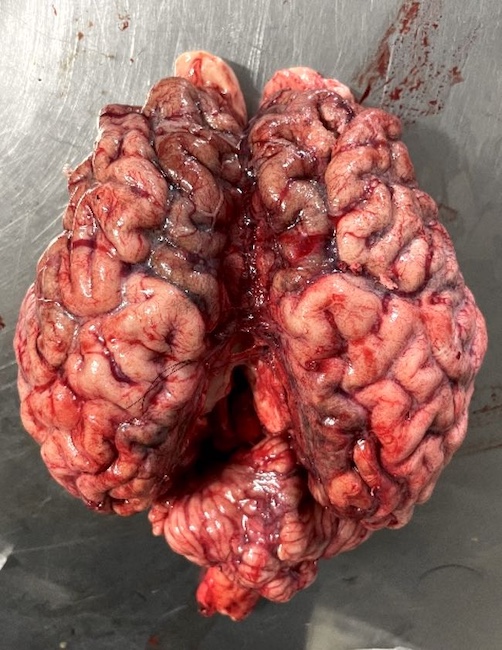
Figure 4. Brain from a cow with neurological signs
SECOND PROPERTY VISIT
Following the initial visit on 29 November 2024, no further cattle developed clinical signs. The cattle displaying neurological signs either died or were euthanised by the owner on welfare grounds, bringing the total number of deaths to 45.
A second property visit was conducted by the second author to confirm the number of dead cattle for insurance purposes. Carcasses were examined on 4 December, five days after the initial mortality event. Forty-five dead and decomposing cows that had been dragged to a central location were examined for surface burns and external lesions (Figure 5). Approximately 10 cows were in a pile and so difficult to examine, while the others were more spread out.
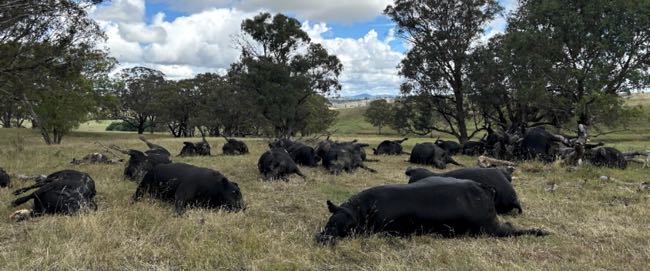
Figure 5. The dead cows, examined five days after the initial mortality event, dragged to a central point for disposal
Almost all cows examined had, approximately circular, bubbles of raised superficial dermis. These bubbles ranged from 2-20 cm in size and were usually in irregular lines but some were in groups. Most were on the upper hindlegs and inguinal area but some were on the rump or neck. The skin over these bubbles was dry, paper thin and could be easily broken with finger pressure. No obvious burns and no singed hairs were seen.
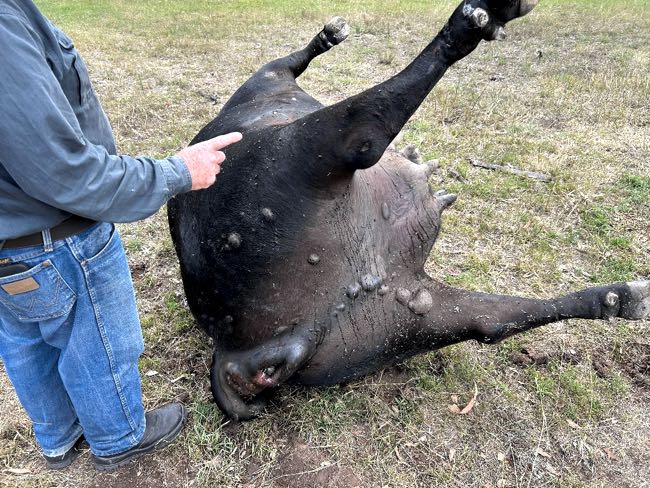
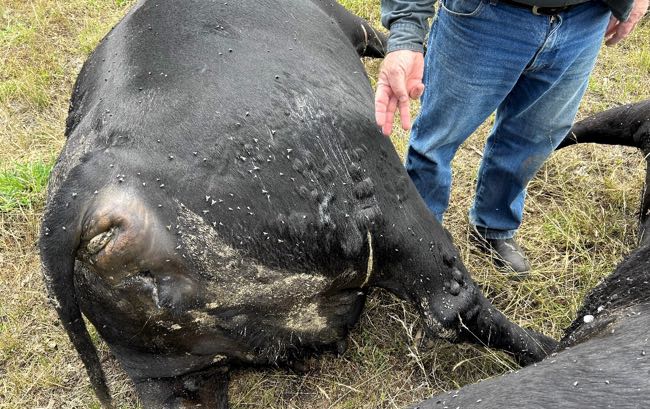
Figures 6 and 7. Intradermal bubbles in two cases
DIFFERENTIAL DIAGNOSES
The differential diagnoses are lightning strike, phalaris toxicity, water deprivation, grass tetany, transmissible spongiform encephalopathy and lead toxicity.
LABORATORY FINDINGS
- Blood tests at a local private veterinary practice (run on Saturday morning 30 December 2024 to determine the need to supplement Mg) showed high Mg levels in the single sample tested (1.33 mmol/L, reference range 0.6-1.1 mmol/L (Parkinson et al. 2019)).
- PMB stained blood smears for Anthrax were negative. Bacillus anthracis PCR was negative.
- Three blood magnesium levels (1.24, 0.85 and 1.04 mmol/L, reference range 0.74-1.44 mmol/L) and four aqueous humour samples (0.85, 0.99, 1.09 and 0.99 mmol/L, reference range 0.61-1.61 mmol/L) all showed as normal.
- Blood sodium levels were within normal range on the two samples tested (both 139 mmol/L, reference range 132-152mmol/L)
- Kidney lead levels were normal (<0.5 µmol/kg wet wt, reference range <2.0 µmol/kg wet wt) in the one sample tested.
- Blood samples collected from live animals showed slightly low calcium levels (1.97 and 1.94 mmol/L, reference range 2.00-2.75 mmol/L), however aqueous humour Ca levels were normal. Potassium levels in aqueous humour were slightly elevated, suggesting that aqueous calcium would likely have been slightly lower at the time of death.
- CK was significantly elevated in the two animals tested (64429 and 3837 U/L, reference range 0-300 U/L).
- Brain histopathology showed no vacuolation in the TSE target sites in the two brains examined. There was no pigment to indicate phalaris toxicity. Both brains had moderate lipofuscin within neurons and the occasional mild vacuolated neuropil (oedema).
- Histopathology of other organs showed mild necrotising lesions in the heart, thought to be peracute. One of the cows had a mild interstitial suppurative pneumonia, thought to be an incidental finding. The other cow had evidence of splenic haemosiderosis.
ADDITIONAL INVESTIGATIONS
A map of lightning strikes during the storm on 28 December 2024 was obtained from lightningmaps.org (Figure 8). This map showed three lightning strikes on the property at 8:07 pm, 8:18 pm, and 9:10 pm. The cattle deaths did not occur in particularly close proximity to any of the strikes. The accuracy of the lightning mapping was not given by the website, and a scale was not present to accurately determine the distance between the reported location of the strikes and the cattle.
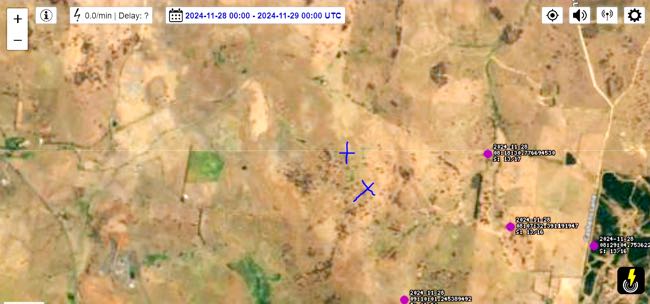
Figure 8. Screenshot of map from lightningmaps.org. The purple diamonds show location and time of lightning strikes. The blue crosses show the approximate location of the cattle deaths.
DISCUSSION
Lightning strike is not an uncommon cause of death in cattle. Diagnosis is simple when linear or arboreal singe lines are present as they are recognised as pathognomonic. In the absence of characteristic singe lines the diagnosis relies on the exclusion of other differentials and a history of lightning strikes in the area.
The diagnosis in this case was made by excluding reasonable differential diagnoses, and the documented lightning strikes in the vicinity of the deaths.
This case is significant in that it appears to be the first report of dermal bubbles as a consistent post-mortem finding in cattle found to have died from lightning strike. The bubbles were not apparent at the initial post-mortem examination, approximately 16 hours after the estimated time of death, however they were very prominent five days after death. Both authors, especially the second author, have observed many dead and decomposing cattle and have not seen lesions of this kind in carcasses before. We suggest that the presence of such intradermal bubbles be considered an adjunct to the diagnosis of lightning strike in cattle.
The case is also significant in that several animals survived the initial insult and displayed neurological signs over the following days. Unfortunately, due to the altered behaviour and gait of the affected animals, a full neurological examination could not be undertaken.There are few published reports of cattle surviving lightning strikes, although neurological signs have been reported in horses and humans post-lightning strike.
Of interest, although 45 cows died either suddenly or subsequently following neurological disease, no calves were affected or died. This finding is difficult to explain. Perhaps the calves were in a group away from the cows or perhaps lightning is conducted less efficiently through smaller animals.
A final significant factor in lightning strike cases is the issue of insurance. Farm insurance policies often cover lightning strike and veterinarians may be required to examine carcasses and provide a report to the insurance company to support the claim. Analysis of lightning strike data and examination for both singe lines and superficial bubbles after several days, can support the diagnosis and presumably the insurance claim.
ACKNOWLEDGEMENTS
Thank you to Luke Milsom, Biosecurity Officer, Central Tablelands Local Land Services, for assistance with the post-mortems. Thank you to Cudgegong Valley Veterinary Services, for running bloods on a Saturday morning. Thank you to the property owner for allowing publication of this report.
REFERENCES
- Suddes H and Neef A (2007) Sudden death in White Suffolk rams www.flockandherd.net.au
- Watt B (2012) A case of presumed lightning strike www.flockandherd.net.au
- Shankar R and Braddon E (2015) Lightning strike in the Riverina www.flockandherd.net.au
- Watt B. (2017) Are linear singe marks pathognomonic for lightning strike in cattle? www.flockandherd.net.au
- Parkinson TJ, Vermunt JJ, Malmo J and Laven R (2019) Editors. Diseases of Cattle in Australasia. A comprehensive textbook, pp 1084-5