
ARCHIVE FILE
This article was published in 1985
See the original document
'WORMKILL' - Strategic Drenching Programme for Northern Tablelands, N.S.W.
S. Love, B.V.Sc., Veterinary Inspector, ARMIDALE
C.S.I.R.O., Pastures Protection Boards and the N.S.W. Department of Agriculture joined forces to launch the WORMKILL programme in the Northern Tablelands in July, 1984. Since that time, the programme has also been applied in slightly modified form to areas adjacent to the Tablelands (near slopes, Upper Hunter). Variations are being considered for other parts of N.S.W.
WORMKILL has so far proven to be effective, reliable and easily applied. With its reduced frequency of drenching, it aims to slow the onset of anthelmintic resistance, a problem widespread on the Northern Tablelands.
NEW ENGLAND ANTHELMINTIC SURVEY
This survey was conducted on 40 properties in Autumn 1984 by P.P. Board and Department of Agriculture veterinarians. Six anthelmintics were used on each property with the faecal egg count reduction technique (4 day interval) used to assess anthelmintic efficacy. (The 4 day interval has been criticised. However, a trial comparing percentage reduction in faecal egg counts on days 1, 2, 3, 4 and 7 post-treatment showed no significant differences in percentage reductions from day 2 for the anthelmintics levamisole, morantel, and oxfendazole. (Dash, 1984).
Table 1
| ANTHELMINTIC | PROPERTIES WHERE DRENCH SATISFACTORY * | ||
|---|---|---|---|
| HAEMONCHUS | TRICHOSTRONGYLUS | ||
| Benzimidazoles | |||
| Thiabendazole x 1.5** | 7/20 (35%) | 18/28 (64%) | |
| Oxfendazole | 18/19 (95%) | 22/29 (76%) | |
| Non-Benzimidazoles | |||
| Levamisole | 17/18 (94%) | 4/33 (12%) | |
| Morantel | 17/18 (94%) | 3/30 (10%) | |
| Narrow Spectrum | |||
| Closantel | 21/21 (100%) | ||
| Napthalophos (600mg.) | 18/18 (100%) | ||
* Egg count reductions >90% were regarded as 'satisfactory'.
** Anthelmintics were used at recommended dose rates except for thiabendazole which was used at 1.5 times the recommended rate.
It is recognised that the faecal egg count reduction technique has limitations. Anthelmintics for example may cause significant reductions in egg counts without a similar reduction in actual worm numbers. This, if anything, means that the New England survey has under-estimated the level of the anthelmintic resistance problem on the Northern Tablelands.
THE WORMRILL PROGRAMME
Various investigations have demonstrated that frequent drenching hastens the development of resistance. (Kettle [1983]; Rural Research in C.S.I.R.O., No. 124).
A recent survey indicated that most Armidale district sheep producers drench frequently (Newman [1984]). On average, ewes were drenched about 7 times a year and their lambs 8 times a year. Most ewes (74%) and lambs (96%) were drenched at intervals of less than 8 weeks during spring, summer and autumn. Many merino and fat lambs were drenched as frequently as every 10 - 28 days during their first summer and autumn.
The WORMKILL programme, with its reduced frequency of drenching, is suumarised below:
Table 2 - Wormkill Programme
| DATE | ADULT SHEEP (& HOGGETS) | LAMBS | ||||
|---|---|---|---|---|---|---|
| Seponver | Broad spectrum drench | Seponver | Broad spectrum drench | |||
| 1 Aug | ∗ | plus | ∗ | |||
| 1 Nov | ∗ | plus | ∗ | ∗ | plus | ∗ |
| 1 Feb | ∗ | ∗ | plus | ∗ | ||
| 1 Apr | ∗ | |||||
∗ = Manufacturer's recommended dose calculated for the heaviest sheep in the group.
DEVELOPMENT OF THE WORMKILL PROGRAMME
A strategic drenching programme developed by Gordon was launched in the 1940's but apparently fell out of favour because, while effective against Trichostrongylus sp., it often failed to control Haemonchus contortus and many sheepmen reverted to monthly drenching. This 'traditional' strategic drenching programme placed special emphasis on the use of drenches in August (pre-lambing) and November (post-lambing) to control worm infections in young sheep. However, while effective against Trichostrongylus sp., this programme is at best 50% effective and at worst quite useless in controlling infections with Haemonchus contortus. (Dash, 1985a).
It is believed that traditional strategic drenching programmes failed because they did not deal with overwintered Haemonchus larvae on pasture. These larvae provide the basis for first and second generation Haemonchus infections in lambs in late spring and summer.
closantel (Seponver (R), with its prolonged action against Haemonchus, provides a way of preventing pasture contamination without the frequent use of broadspectrum drenches.
In 1983/84 at Armidale WORMKILL (broadspectrum drench plus Closantel) was compared with the 'traditional' strategic drenching programme (broadspectrum only) and with Closantel alone. Drench dates were August and November. Results are summarised below:
Table 3
Effects of Different Drench Treatments on Live Weight (LW) Gains & Deaths
| TREATMENT | L.W. GAIN (KG.) | DEATHS % | ||
|---|---|---|---|---|
| EWES | LAMBS | EWES | LAMBS | |
| None | -0.7 | 4.3 | 4 | 82 |
| Broadspectrum | -1.0 | 8.8 | 8 | 56 |
| Closantel | 0.2 | 8.6 | 0 | 25 |
| Closantel & broad spectrum | 1.0 | 10.9 | 0 | 0 |
(Dash, 1985b)
Table 4 Geometric Mean Worm Counts - Lambs (February)
| TREATMENT | H. CONTORTUS | OSTERTAGIA sp. | T. AXEI | T. COLUBRIFORMUS | NEMATODIRUS |
|---|---|---|---|---|---|
| None | 19600a | 10850a | 3950a | 6020ab | 6250a |
| Broadspectrum | 18400a | 2670b | 270b | 1010c | 3720a |
| Closantel | 250b | 3460b | 1800a | 6940a | 5560a |
| Closantel & Broadspectrum | 50b | 2860b | 360b | 2440bc | 3150a |
(Within columns, different superscripts indicate significant differences. (p < 0.05).) (Dash, 1985b).
ACCEPTANCE OF WORMKILL
C.S.I.R.O., P.P. Board and Department of Agriculture veterinarians launched the programme in July, 1984 using mailed brochures, newspaper and magazine articles, radio interviews, seminars and field days. Livestock officers also assisted. Additionally, one-to-one personal and telephone contacts were considerable. The response was gratifying with about 85% of producers surveyed in the Armidale district adopting the programme in its first year. (Newman, 1984).
WORMKILL, MONITORING - NORTHERN TABLELANDS
Veterinarians have been continuously monitoring the programme in the field.
Results for the Northern Tablelands are shown below. An upper limit of 500 worm eggs per gram faeces has been selected as a 'benchmark' for Wormkill flocks.
Monitoring - Spring 1984 (2-3 months after August drench)
Table 5
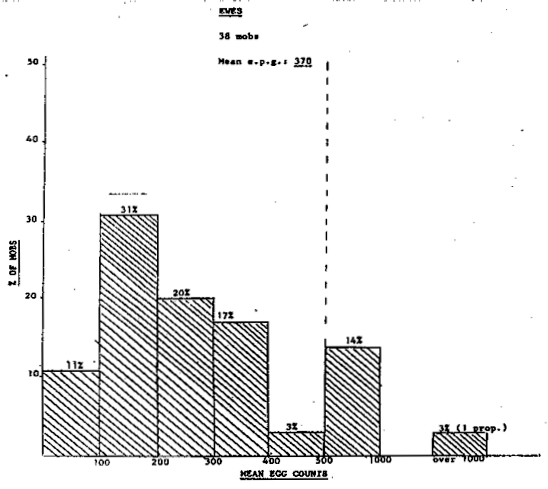
Monitoring - Spring 1984
Table 6
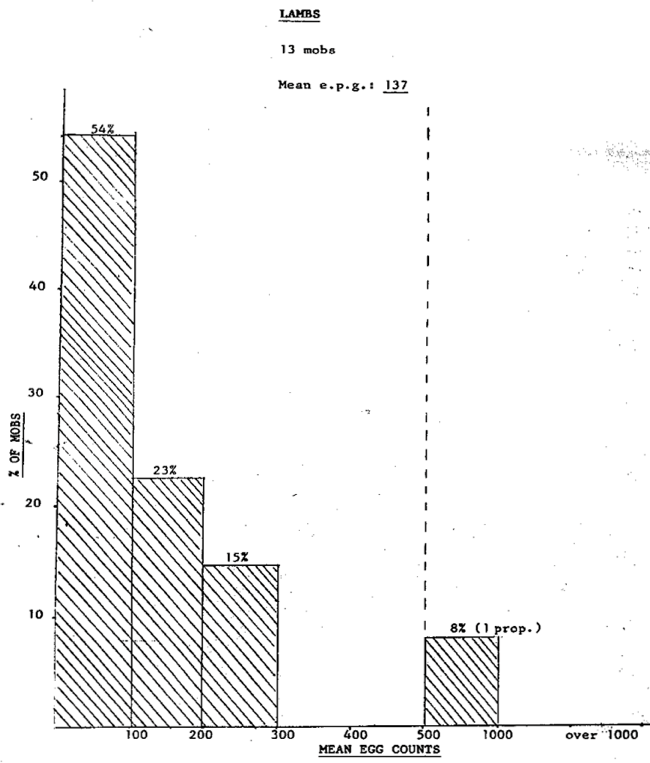
Monitoring - Spring 1984
Table 7
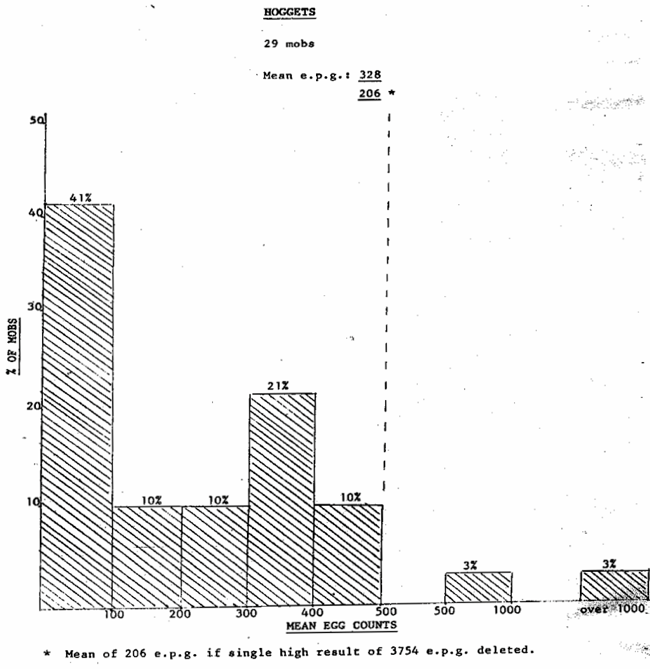
Monitoring - Summer 1985
(2 - 3 months after November, 1984 drench)
Table 8
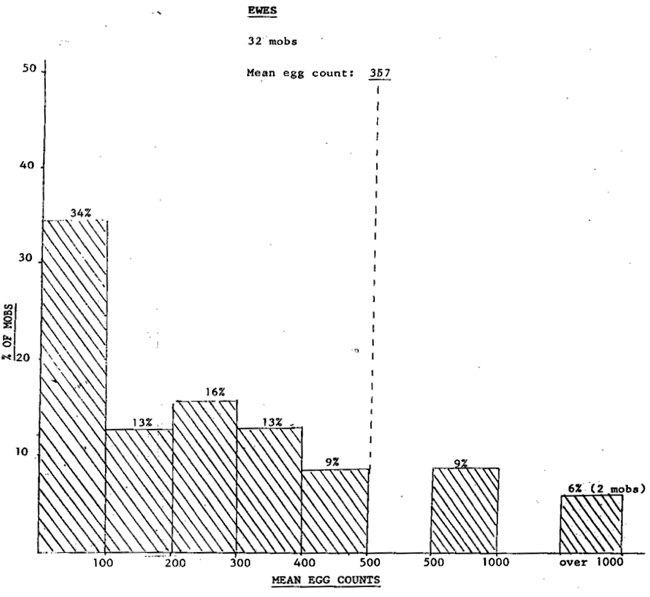
Monitoring - Summer 1985
Table 9

CONCLUSION
The WORMKILL programme is a strategic drenching programme designed to reduce selection for anthelmintic resistance, and appears to be effective and reliable; is simple to implement, and has widespread producer support.
Additional short-term benefits for many producers include reduced labour costs associated with drenching, and reduced total outlays for anthelmintics.
REFERENCES
Dash, K.M. (1984) - pers. comm.
Dash, K.M. (1985) - Rural Res. in C.S.I.R.O. (in press)
Dash, K.M. (1985) - Pers. comm., and paper in press ('Control of helminthosis in lambs by strategic treatment with closantel and broad spectrum anthelmintics'; Aust. Vet. J., 1985)
Kettle, P.R. et al. (1983) 'A Survey of nematode control measures used by milking goat farmers and of anthelmintic resistance on their farms.' New Zealand Veterinary Journal 31 (1983) 139-43
Newman, R. (1984) 'Worm control in sheep on the Northern Tablelands of N.S.W.; A Survey of farmer's opinions' R.L. Newman, Report, Dept. Ag. Econ. and Business Management. Univ. of New Eng., 1984. [cited by Dash, K.M. (1985a) Rural Res. in C.S.I.R.O. (in press)]
Various local publications by K.M. Dash and S. Love.