
ARCHIVE FILE
This article was published in 1977
See the original document
Pesticide Residues in the Forbes Pastures Protection District
J.B. Kemp, B.V.Sc., Veterinary Inspector, Forbes
INTRODUCTION
D.D.T. was first synthesised by a German chemist in 1874, but its properties as an insecticide were not discovered until 1939 and it has been used extensively for this purpose throughout the world for three decades. D.D.T. is an organochlorine insecticide and its chemical name is dichloro-diphenyl-trichloro-ethane.
USES OF D.D.T. IN THE FORBES PASTURES PROTECTION DISTRICT
The main use of D.D.T. has been for lucerne seed production. Other crops involved have been sunflower, linseed and tomatoes. D.D.T. is used to control Heliothis. It has also been used to control Red Legged Earth Mite, although application rates are lower than for Heliothis.
LUCERNE SEED INDUSTRY IN THE FORBES PASTURES PROTECTION DISTRICT.
Lucerne seed is grown along the Lachlan Valley and the Forbes area has been the largest lucerne seed producing area in N.S.W., e.g. in 1973-74 season Forbes produced 816 tonnes out of the 915 tonnes produced in N.S.W. South Australia is the next largest producing State of Australia and in that year produced 745 tonnes. In the 1973-4 season, 7,800 hectares were harvested along the Lachlan Valley. According to the records of the District Agronomist, Parkes, lucerne seed has been grown in the Forbes area at least since 1958 and D.D.T. would have been used then. According to a Forbes farmer, lucerne seed production has been going on at least since the 1920's.
The Lucerne seed industry at Forbes has brought in an income in excess of half a million dollars a year in recent years. However, in the 1975-6 season, production was well down, being only 208 tonnes. This was due to severe floods during the 1974 and 1975 springs and it is difficult to say what effect the Stock (Chemical Residues) Act has had on production as the Act only came in during the latter part of 1975.
THE USE OF D.D.T. FOR LUCERNE SEED PRODUCTION
D.D.T, is usually sprayed twice per crop at the rate of 3½ pints/acre (or 1 lb. of active ingredient) which is the same for cotton per application but there are far fewer applications than for cotton. Usually there is one crop per year on different paddocks. D.D.T. is only used for lucerne seed production and not for pastures for grazing or hay production. Lucerne seed production is a risky enterprise due to the uncertainty of flower pollination and the requirements of certain weather conditions. Therefore many paddocks are shut up for seed without being harvested. Therefore lucerne seed production and cattle raising are complementary enterprises. Cattle are put into lucerne paddocks either if the seed fails or after harvest.
D.D.T. TRACEBACKS IN THE FORBES PASTURES PROTECTION DISTRICT
Maximum Residue Level (M.R.L.) for D.D.T. : 5.O ppm.
A total of 138 letters went to owners with a D.D.T. traceback during 1976; there were 70 replies (just over 50%). Of these 70 replies, 41 had shown a history of D.D.T. application on their properties and the remaining 29 owners had not used D.D.T.
Eleven of the 41 properties that had a history of using D.D.T. had not used D.D.T. for a period of 5 to 10 years, and levels ranged from 0.05 ppm to 0.34 ppm. One property which had a traceback in January this year of 0.22 ppm, had no D.D.T. applied for 20 years and then it had been applied only on one or two occasions on one paddock at a time.
PROPERTIES ON WHICH THERE WAS NO HISTORY OF THE USE OF D.D.T.
There was a total of 34 tracebacks from 29 properties which had no history of D.D.T. use. 25 of these 34 tracebacks had a level of 0.1 ppm or less. This figure corresponds with that when there was international concern regarding the possible effect of residues in areas where no pesticides were used. A survey was undertaken of organochlorine residues in wildlife in eleven countries considered free of pesticide usage, for the period 1967-8. The minimum degree of contamination in the environments examined were considered to be levels of 0.01 to 0.1 ppm and levels above 0.1 ppm were regarded as evidence of localised pollution.
Three of the properties that had no history of D.D.T. use had trace backs of more than 1.00 ppm. Two of these properties had a present ownership of only a relatively short period. One property with 1.14 ppm traceback had been owned for 3 years and the owner had bought hay from an unknown history regarding D.D.T. The other property with a similar length of ownership by the present owner is very subject to flooding (1.3 ppm). The owner with the third traceback of 16.00 ppm bought and sold cattle.
DIFFICULTIES ENCOUNTERED WITH THE STOCK (CHEMICAL RESIDUES) ACT IN THE FORBES PASTURES PROTECTION DISTRICT
1. Lack of a comparable alternative to D.D.T. 'Endosulfan' is being used in place of D.D.T. for lucerne seed production but this chemical had the following disadvantages:—
(a). Shorter residual effect. The number of applications are increased from 2 for D.D.T. to 4 or 6 for 'Endosulfan'.
(b). Cost. The cost of one application is more than 200% per acre than for D.D.T.
(c). Safety. Assuming, that the rat and the rabbit have similar dermal toxicities, 'Endosulfan' is 7 times as toxic via the dermal route than D.D.T.
(d). Effect on bees. Bees are necessary for the pollination of lucerne for seed and 'Endosulfan' is more toxic than D.D.T. on bees.
Due to the far greater cost factor in using 'Endosulfan' it is expected that the production of lucerne seed in the Forbes area will fall considerably.
Advantage of 'Endosulfan':- 'Endosulfan' does not accumulate in the milk, fat or muscle of animals. 'Endosulfan' is a chlorinated hydrocarbon (Guide to Pest Destroyers, Dept. of Agriculture, NSW 1969-70) but it is not included under the Stock (Chemical Residues) Act.
2. Competition from other lucerne seed producing states where they can use D.D.I. without the restrictions of the Stock (Chemical Residues) Act on cattle raising.
3. There has been a certain amount of feeling by some farmers who have had cattle quarantined where instructions as to the use of D.D.T. have been followed prior to the enforcement of the Act., e.g. withholding periods. These farmers feel that there has been an insufficient breaking-in period for the Act.
ACCUMULATIVE ASPECTS OF D.D.T. IN THE ENVIRONMENT.
Characteristics of D.D.T.
D.D.T. and its metabolites persist in the aquatic and terrestrial environments. Once disbursed D.D.T. is an uncontrollable chemical which can persist in soil for years and even decades and can be transported from sites of application by drift during aerial application, vaporisation from crops and soils, by leaching, erosion and run-off, D.D.T. can be attached to eroding soil particles.
2. D.D.T. is insoluble in water.
3. D.D.T. collects in fat tissue.
4. D.D.T. collects in the food chain and accumulates in various species of organisms and it builds up in the organism and becomes magnified as the organism becomes more complex, e.g. water to phytoplankton to fish to birds to mammals.
5. D.D.T. is toxic to fish.
6. D.D.T. is a contaminant of freshwaters, estuaries, and the open ocean and it can be found in remote areas or in ocean species such as whales, far from any known area of application.
7. Organochlorine insecticides may accumulate in 'Small' amounts in plant tissues, especially root crops, but Stickel (1973) found that in all available data there was no instance where the residue in the plant was greater than that in the soil in which it was grown. However, if the animals are grazed, there is a possibility of soil intake which could cause residue levels above the tolerance.
8. Insecticides do concentrate in aquatic plants, probably because the insecticide has greater affinity for the plant than it has for the water. Water cultivated crops such as rice absorb larger quantity of residues than crops crown under normal agricultural practices.
D.D.I. IN THE ENVIRONMENT (Fig. 1).
1. SOIL
Menzies (1972) reported an approximate half-life of 3 to 10 years.
Edwards (1966) reported figures of 4 to 30 years, with an average of 10 years, for the time required to remove 95% of applied D.D.T. from soil areas.
Freed (1970) referring to the half-life of D.D.T. from the Pacific Coast environment in the U.S., stated that D.D.T. disappearance from the surface of a moist, warm agricultural soil will be rapid with a half-life of less than a year, brought about by vaporisation, photodecomposition and chemical decomposition; if the chemical is applied deeper in the soil (6" to 8") the half-life will be 10 years or more, D.D.T. residues will remain for a longer period of time in soil high in organic matter (Lichtenstein 1969).
With time the pesticide may be released from the soil surface and may move with particulate matter in the direction of flow of either surface or subsurface water and a portion of it may eventually travel great distances, in a sequence suggested by Le Grand (1966) from soil surface to:—
a). zone of aeration, or the zone between the soil surface and the water table.
b). zone of ground water movement to a stream.
c). stream course
d). the sea. The pollutant may be concentrated by biological, chemical and physical processes which may lead back to man through food resources obtained from the sea.
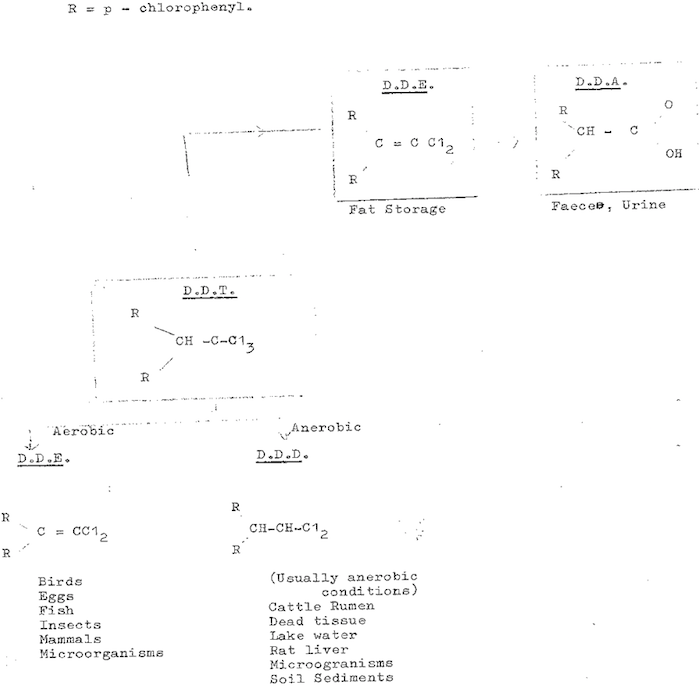
2. MICROORGANISMS (Fig. 2).
It is only in recent years that D.D.T. has been shown to be metabolised by microorganisms. It was in 1963 that D.D.D. was shown to be formed from D.D.T. in animal tissues.
Considerable evidence now exists that many diverse microbial organisms including bacteria, fungi and algae are capable of degrading D.D.T. and some of its metabolites. These organisms are positioned in the lower end of the food chain and take part in pesticide buildup. The major route of D.D.T. metabolism by microorganisms is through D.D.D. formation under anaerobic conditions, and under aerobic conditions, D.D.E. is the prime D.D.T. metabolite. D.D.E. appears to be a stable end product incapable of being further degraded. The Board of Tick Control Laboratory at Lismore adds the 3 components of D.D.E., D.D.D. and D.D.T. for a total D.D.T. result.
This follows the Australian D.P.I. practice and fulfils the requirements of the meat trade (J. Dingle, Board of Tick Control Laboratory, Lismore).
3. AIR
The atmosphere contains many pollutants concentrated in some areas more than others, and they include pesticides in the form of vapour, aerosols, or suspended micro-particulate matter.
Pesticide applications to a target area are made by either aerial or surface techniques, and air will be the medium through which the pesticides will move to their intended target. Some of the aerial spray will not reach the ground and it will be circulated via air currents and the wind or drift in the atmosphere. Thermal and wind conditions will affect the dispersion and distribution of the pesticide at the time of application. Drift problems are greater with aerial than with surface spraying.
Pesticide particles of small diameter are the greatest hazard for non-target contamination.
Long distance transportation of dust was proved to be possible by Cohen & Pinkerton (1966). These authors stated that pesticides could travel great distances and survive photochemical reactions at high altitudes.
Harrison et al. (1970) consider the 'input' of D.D.T. from the atmosphere to the land surface to be vaporised D.D.T., particulate D.D.T., and precipitation; similarly, the 'output' from land surface to the atmosphere are vaporised DDT and D.D.E, and particulate D.D.T. and D.D.E. Woodwell et al. (1971) noted that D.D.T. residues will be removed from the air not only by precipitation but also by air-sea interface reactions and chemical degradation. These authors also note that D.D.T. will volatise from plants and soil, and they have calculated an equilibrium concentration of D.D.T. in the atmosphere and suggest that the atmosphere is a potentially large reservoir for residues.
Residue Reviews (1976) states that although usage of D.D.T. in the U.S. may be curtailed completely, it is obvious that residues will be continually added to the U.S. area via transport in the atmosphere from other areas of the world that continue to use D.D.T.
4. RAINFALL
Woodwell et al.. (1971) suggested that rainfall is probably the dominant mechanism for the removal of D.D.T. from the atmosphere. A recent report (SCEP 1971) notes that the residence time of particles in the troposphere varies from 6 days to 2 weeks; in the lower stratosphere (illegible) size particles or smaller may remain suspended for 1 to 3 years. These authors further state that most of this residue would go into the oceans. The U.S. Department of Interior in the Antarctic study on penguins and seals found D.D.T. residues i.e. in an area far removed from any pesticide usage. (anon 1965).
5. WATER & SEDIMENTS.
Storm water flow (SCCWRP 1972) increases local concentration of residues in the water; D.D.T. residues are diluted to a very low concentration in marine waters (Cox 1971).
Johnson & Morris (1971) observed a relationship of pesticide residues in the Iowa river waters with the amount of surface runoff water entering the river, seasonal application of pesticides and the location of the river with reference to nearby heavy row-crop agriculture; a significant amount of the residue was present in the suspended matter in the water samples.
Miles & Harris (1971) noted an apparent correlation between the concentration of D.D.T. in the creek water under study and the rainfall, i.e. periods of increased rain produced increased D.D.T. concentrations in the water. D.D.T. residue in the bottom mud was 820 to 13,000 times the concentration in the water; fish (sucker, chub, catfish) obtained from this water area contained 50,000 to 80,000 times (600 to 1,000 ppm) the residue concentration found in the water.
Bog soil, utilised in cranberry production in the U.S.A., 13 years after the last D.D.T. application, contained 3.57 ppm of D.D.T. in the top 2" of the soil. Horizontal movement of the insecticide was noted in the direction of the runoff floodwater and it was concluded that this type of soil was a long-lasting reservoir of D.D.T. and that sprinkler irrigation techniques were preferable to flooding because of reduced movement of D.D.T. to stream areas.
PROPERTIES IN QUARANTINE FOR D.D.T. IN THE FORBES PASTURES PROTECTION DISTRICT
The maximum residue, level for D.D. is 5.0 ppm.
PROPERTY 1.
This property had had a history of lucerne seed production with D.D.T. spraying over a number of years.
The cattle on this property were initially divided into 2 groups - namely a cow group and a yearling group. The cow group and the yearling group were tested in December, 1975, the cow group giving a maximum level of 24.6 ppm and the yearling group a maximum level of 10.4 ppm.
At the end of March, 1976 the animals from a third group, a vealer mob were tested. This resulted in all 10 animals having below maximum levels of D.D.T. but 2 animals had above maximum residue levels for dieldrin - one of 0.4ppm and the other 0.59 ppm (maximum residue level (MRL) is 0.2ppm). The paddock in which the vealers had been grazing on was sprayed with D.D.T. one to two years previously.
These two nine month old animals were weaned on the 14.5.76 and retested on the 19.5.1976. On that date the vealers were moved to a new lucerne paddock which was last sprayed with D.D.T. thirteen years previously. This second test resulted in the vealers being satisfactory for dieldrin (both <0.05 ppm) but one animal showed an above M.R.L. for D.D.T. (5.5 ppm). This animal was previously 1.51 ppm. This animal with the increased D.D.T. level was retested 12 days later and showed a further D.D.T. rise to 6.4 ppm D.D.T. No reason for this rise could be determined.
This property was the first that was quarantined for D.D.T. in the Forbes district which was in December, 1975. The 3 mobs were again tested on 25.8.1976 which resulted in the cow mob and the vealer mob being released. The yearling group which had a highest level of 10 ppm remains in quarantine.
PROPERTY TWO
The second property was quarantined after a traceback of just over the MRL was detected, 5.2. ppm. The source of the D.D.T. was spraying of D.D.T. eleven months earlier for Heliothis on Lucerne seed. The cattle were put on thrashings after a three week withholding period. Initial field testing resulted in one mob out of 6 mobs having excess levels (maximum 7.1 ppm). Quarantine was released after 4½ months. The spraying eleven months previously was the first that had been done for 7 years and was on 70 acres.
PROPERTY THREE
The origin of the D.D.T. was aerial spraying of a sunflower crop, five weeks prior to slaughter of the two animals detected. The animals were in an adjoining paddock. The highest of the two tracebacks was 13.O ppm. On field sampling, all samples were below the M.R.L.
PROPERTY 4.
This was a traceback of 18.00 ppm. No D.D.T. had been used on this property for 8 years when lucerne was sprayed for Red Legged Earth Mite which requires a lower rate of D.D.T. application than for Heliothis, which is 4 oz. of A.I. (Active Ingredient) per acre and this was the only time of spraying.
The apparent source of the D.D.T. was hay which had been purchased 3½ years earlier. This had had been sprayed with D.D.T. as the crop had been intended for lucerne seed.
Sampling of this herd resulted in one animal having an excess D.D.T. level (6.28 ppm). This animal was resampled 3 months later and its D.D.T. Level had increased by 1.62 ppm to 7.9 ppm. Between the two sampling dates, this animal had had no access to the contaminated hay, nor had it grazed the paddock which had been sprayed 8 years earlier. Also, the animal had gained in weight (heifer 18 months old). No neighbours had used D.D.T. Therefore, the reason for the rise in D.D.T. level is unknown.
On the third resampling of this animal, the heifer was in poor store condition. A sample was taken from each side and there was a further rise in total D.D.T. - the left side 13.0 ppm and the right side 11.4 ppm. On the two previous occasions, the samples were taken from the right side and so the side not sampled previously showed a higher level (i.e. 1.6 ppm higher).
PROPERTY FIVE
The highest level recorded in the Forbes district was a traceback of 121.0 ppm D.D.T. in a yearling steer. The source was aerial spraying of D.D.T. seven months earlier or a 100 acre paddock growing, Lucerne seed. It was possible that the cattle had been in an adjacent paddock at the time of spraying. The lucerne was stripped of seed, and the cattle put on the paddock two months after spraying.
Most of the cattle had been sold from this property prior to the traceback. Sampling of a proportion of the 30 animals remaining resulted in the release of the property from quarantine.
PROPERTY SIX
This property had a traceback of 26.0 ppm in a yearling heifer. D.D.T. had only been used on one crop in this farm, which was for Lucerne seed. One spray was applied in February and one spray in March and the animal slaughtered seven months afterwards. There was a 72 day withholding period and then the cattle were given access to the thrashings and new regrowth, The D.D.T. was purchased early in 1976 and the directions on the tin advised a 50 day withholding period for grazing or cutting for hay.
Sampling of this property resulted in samples having below maximum residue levels.
PROPERTY SEVEN
The first four animals with levels exceeding the maximum residue level D.D.T. were slaughtered at the end of September, 1975. Levels of the six slaughtered animals ranged from 12.0 ppm to 2.6 ppm the highest level being the leanest carcase and the lowest level in the fattest animal. This herd had been sold prior to the traceback so no quarantine or follow up testing was done.
The last reported spraying on this property was in September, 1974 when 120 acres of linseed were sprayed by air. Prior to that, this property has had a history of regular spraying of D.D.T. for lucerne seed. In 1969, 3000 acres were sprayed with D.D.T. from the air.
Then in February, 1977 the new occupiers of this property received a traceback of 8.5 ppm D.D.T. The new occupiers had never applied D.D.T. Over a period of 1½ years. One mob of 200 cattle was quarantined. They had received other tracebacks, the previous highest being 3.5 and 3.6 ppm in January, 1977.
ANOTHER PROPERTY WITH A HISTORY OF D.D.T. - NOT QUARANTINED
This property has not exceeded the M.R.L. for D.D.T.
The last spraying on this property was in Jan-Feb. 1974 for lucerne seed on 200 acres. The rate was 12 pint/acre and it was applied from the ground. There was a three month withholding period. Thrashings had been left on the paddock. Only one spray application was used.
The first spraying on the property was in 1972 when 700 acres were sprayed from the air. In March, 1973, 500 acres were sprayed twice at two pints per acre. There was a two month withholding period.
In December, 1973 there was a traceback of 4.2 ppm.
In December, 1975 there was a traceback of 3.7 ppm.
In January, 1976 there was a traceback of 3.6 ppm.
In March, 1976 there was a traceback of 2.4 ppm.
In January, 1977. there was a traceback of 2.1 ppm.
Therefore, over a period of 3 years, the maximum level had halved.
PROPERTIES QUARANTINED FOR DIELDRIN IN CATTLE
Two properties have been quarantined in the Forbes Pastures Protection Board area due to above maximum residual level of dieldrin. (Maximum residue level (M.R.L.) of Dieldrin - 0.2 ppm).
PROPERTY 1.
The first property in the Forbes P.P. District over the M.R.L. for dieldrin was property 1 quarantined for D.D.T. Ten vealers tested from a vealer mob had below maximum residue levels of D.DT. but two animals had above M.R.L. for dieldrin - one of 0.4 ppm and the 0.59 ppm.
No dieldrin had been used on the property but the vealers had access to two State Electricity Commission poles which had been treated with a creosote/dieldrin mixture twelve months previously.
PROPERTY 2.
This property had a traceback of 0.39 ppm dieldrin in a yearling steer. Again, no dieldrin had been used on this property. Two weeks prior to the sale of the cattle, the Central West County Council had treated one electricity pole in the paddock in which the cattle were grazing. The C.W.C.C. later advised that Dieldrin had been used on this pole as an additive to creosote, this mixture having been used for a period in excess of 20 years.
On testing 20 animals, two resulted in having excess dieldrin levels, 1.3 and 0.21 ppm.
Testing 4 months later resulted in 1.3 ppm animal reducing to <0.05 ppm and 0.21 ppm reduced to levels of 0.12 and 0.09 ppm. One sample was taken from either side of the animal, the same side sampled previously having the higher level.
PROPERTIES HAVING TRACEBACKS BELOW THE M.R.L. FOR DIELDRIN
Six properties that were traced back for dieldrin, had electricity poles on them. Four tracebacks had levels over the 50% M.R.L. (2 at 0.17 ppm; 0.24 and 0.13 ppm). The time of treatment of poles ranged up to 12 months previously.
Dieldrin is now not used on electricity poles in the Forbes District, either by the C.W.C.C. or the State Electricity Commission.
There was no other source established on properties with dieldrin tracebacks other than that from electricity poles.
SUMMARY OF PROPERTIES QUARANTINED FOR D.D.T. IN THE FORBES PASTURES PROTECTION DISTRICT.
There have been a total of 7 properties quarantined for excessive levels of D.D.T. in cattle. Five of these properties had a history of D.D.T. application for lucerne seed. On one property D.D.T. was used for sunflower; and on the other property, hay which had been bought in 3½ years previously had been sprayed with D.D.T. by the vendor when the Lucerne was intended for seed. Four of the seven properties quarantined were released after the initial field testing. The property which was the first to be quarantined in December, 1975, remains in quarantine, although 2 herds of the 3 on the property have been released.
PROPERTY WITH A D.D.T. HISTORY AND NOT QUARANTINED.
This property was last sprayed with D.D.T. in Jan-Feb., 1974 for lucerne seed. There have been several tracebacks over 3 years which showed the maximum D.D.T. level being halved from 4.2 ppm to 2.1 ppm over the 3 year period to January, 1977.
PROPERTIES WITH OVER THE M.R.L. FOR H.C.B.
There have been two properties quarantined for excessive H.C.B. levels in cattle. One was released after the first field sampling; the other property has only just been sampled. The cause of the H.C.B. in cattle in the first property was cattle breaking into a shed containing old seed wheat. On the second property the cause was not determined.
CONCLUSIONS
1. It is expected that since the introduction of the Stock (Chemical Residues) Act in the latter part of 1975, Lucerne seed production in the Forbes P.P. District will fall considerably. This is due to the lack of a comparative alternative to D.D.T. in respect to residual effect and cost, and the competition from other lucerne seed producing states that have no Stock (Chemical Residues) Act.
2. Results of two comparative samplings of both sides of two animals at the one time have been obtained. One was for dieldrin. These levels were 0.12ppm and 0.09 ppm giving a difference of 0.03 ppm, the side sampled previously having the higher level. With a M.R.L. of only 0.2ppm, this difference for a borderline case could mean the difference of a herd either remaining in quarantine or being released.
The second comparative sampling of one animal was for D.D.T. on Property 4. One side sampled had a level of 13.0ppm and the other 11.4ppm D.D.T. The side not previously sampled showed the higher level. This was the third time of sampling of this animal over 7 months.
3. Two animals, one from each of different properties, have shown a continuing D.D.T. rise, without an apparent source of D.D.T. One animal's level rose from 1.51 ppm to 6.4ppm over two months. This animal had first been grazing on land which had been sprayed with D.D.T. one to two years previously for lucerne seed and showed a rise to 5.5ppm. Then it was put on land which had not been sprayed for 13 years and gave a further rise to 6.4ppm, (Property 1).
The second animal (Property 4) was sampled 3 times and the level rose from 6.28 to 13.00 ppm over a period of 7 months. No D.D.T. had been used on the property for years when lucerne was sprayed for Red Legged Earth Mite. The original suspected source of D.D.T. was bought-in hay which had not been used since quarantine of the property.
4. D.D.T., together with other organochlorine insecticides, is a highly persistent substance in the environment and has the effect of accumulating in the fat tissues of animals. For this reason it was found necessary by the Department to introduce the Stock (Chemical Residues) Act, together with pressure from importing countries of Australian meat to have D.D.T. levels below a certain level.
5. Effect on man. D.D.T, and closely related compounds are the most ubiquitous and predominant of all pesticide residues in man. On the basis of present knowledge, the only unequivocal consequence of long term exposure to persistent pesticides at levels encountered by the general population, is the acquisition of residues in tissues and body fluids. No reliable study has revealed a causal association between the presence of these residues and human disease (Mrak, 1969).
ACKNOWLEDGEMENTS.
1. Acknowledgement is given with thanks to the District Agronomist, Parkes (Mr. D. Gammie), for information given on the lucerne seed industry along the Lachlan Valley: also to
2. Mr. John Dingle for reading the paper and for his helpful comments; (Board of Tick Control Laboratory, Lismore).
3. To the District Veterinary Officer, Orange.
4. Mr. T.H. Johns, Director, Pesticides & Environmental Studies, Biological & Chemical Research Institute, Rydalmere, for reading the paper.
5. Mrs. M. Woodford for the typing.
REFERENCES
A. Bevenue - The 'Bioconcentration' aspects of D.D.T. in the environment. Residue Reviews (1976) p.37-112 (Springer-Verlag)
Silent Spring by Rachel Carson 1962 (Penguin Books)
FIGURE 1
TRANSFER OF RESIDUES OF ORGANOCHLORINE INSECTICIDES IN THE ENVIRONMENT (PESTICIDE REVIEWS - VOLUME 61)
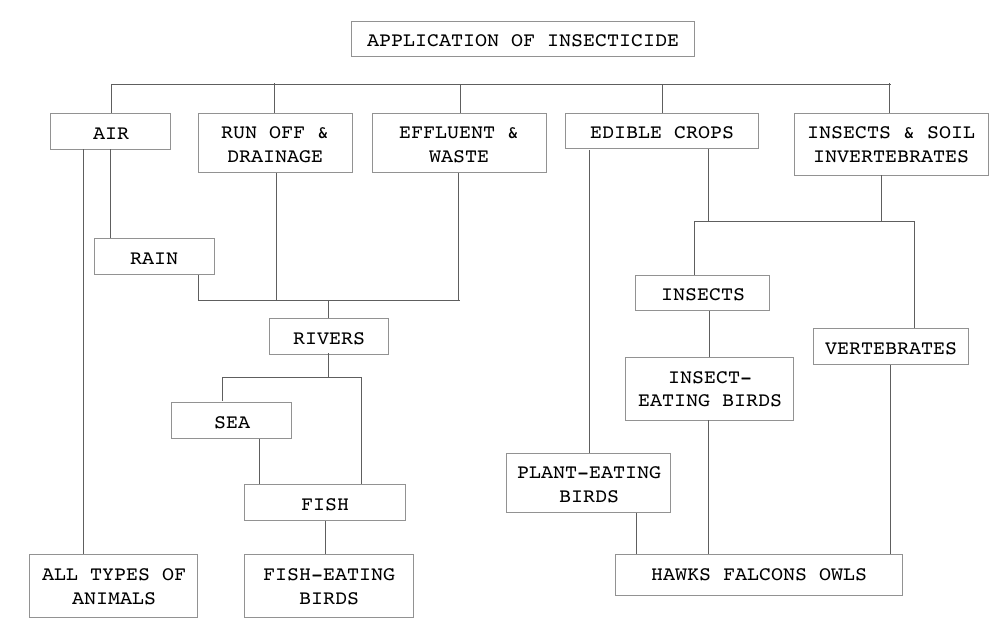
FIGURE 2. (PESTICIDE REVIEWS - Volume 61) Oversimplified Diagram of the Fate of D.D.T. in the Environment
SUMMARY OF PROPERTIES IN QUARANTINE FOR D.D.T.
| PROPERTY No. | SOURCE OF D.D.T. | INITIAL D.D.T. LEVEL AT T/B | RELEASED AFTER 1st FIELD SAMPLING | PERIOD IN QUARANTINE | WITHHOLDING PERIOD | PROBLEMS OR COMMENTS |
|---|---|---|---|---|---|---|
| 1. | D.D.T. for lucerne seed over a number of years. | 21.0 ppm | No | Quarantined in 12/75. 2 herds/3 released after testing 8/76 | 58-63 days | 1 herd remains in quarantine. Problem with dieldrin in vealers preventing release. Also problem of rising D.D.T. level in vealer mob. |
| 2. | Spraying for lucerne seed 11 months previously. | 5.2 ppm | 5/6 mobs released | 1 mob in quarantine for 4½ months | 3 weeks | The spraying 11 months previously was the first for 7 years. |
| 3. | Aerial spraying of sunflower crop. | 13.0 ppm | Yes | Form 1 Detention 11½ weeks. | - | Animals were in adjoining paddocks to the spraying. |
| 4. | Suspected source - hay sprayed from lucerne seed bought 3 yrs. previously. | 18.O ppm | No | Quarantined 19.7.76 and remains. | Problem of rising D.D.T. levels in a heifer without any known source of D.D.T. Level rose from 6.28 ppm to 13.0 ppm over seven months. 2 sides sampled on the one animal showed 13.0 ppm and 11.4 ppm, the side not previously sampled showing the higher level. No spraying done on this property for 8 years. (for Red Legged Earth Mite). | |
| 5. | Aerial spraying for lucerne seed 7 months previously. | 121.00 ppm | Yes | Form 1 Detention, 2½ months. | 2 months | Highest traceback level to date in Forbes P.P. District. Owner sold the bulk of his cattle prior to the traceback. |
| 6. | For lucerne seed 7 months previously. | 26 ppm | Yes | Form 1 Detention 6½ weeks. | 72 days | D.D.T. had only been used once on this property. |
| 7. | For lucerne seed 2½ years previously | 8.5 ppm | Results to come. Results 24.3.77 Yes. | Quarantined on 28.2.77 Released 25.3.77 | D.D.T. last used 2½ yrs previously. | Occupiers of this property have changed hands. Present occupiers have never used D.D.T. D.D.T. not used for 2½ yrs. Prior to this property had history of heavy D.D.T. usage. |
PROPERTY WITH A D.D.T. HISTORY AND NOT QUARANTINED.
| PROPERTY No. | SOURCE OF D.D.T. | INITIAL D.D.T. LEVEL AT T/B | RELEASED AFTER 1st FIELD SAMPLING | PERIOD IN QUARANTINE | WITHHOLDING PERIOD | PROBLEMS OR COMMENTS |
|---|---|---|---|---|---|---|
| 1. | For lucerne seed. | 4.2 ppm | no field sampling | not quarantined | 2 months after last spraying | Last D.D.T, spraying in Jan-Feb. 1974 (and the first spraying in 1972). Several tracebacks over a 3 year period have showed the maximum D.D.T. level being halved from 4.2 ppm to 2.1 ppm. |