
ARCHIVE FILE
This article was published in 1963
See the original document
INSTITUTE OF INSPECTORS OF STOCK OF N.S.W. YEAR BOOK.
Current Research on Face Cover as it Affects the Fertility of Merino Sheep
By R. B. DUN, B.V.Sc., Ph.D., Wool Research Laboratory, Trangie
Fertility is the most important economic characteristic of Merinos:
1. Average levels are low, mainly due to extensive management at mating and lambing.
2. Lift in fertility gives more surplus sale sheep and higher possible culling rates.
3. Increased stocking rate is the major recommendation from wool production studies on improved pasture. These sheep have to be bred in Australia by raising fertility so that present levels of mutton and lamb consumption can be maintained. In many cases this increase in sheep numbers must be achieved on the individual property as many graziers have a well-based prejudice against stock purchase.
Our approach to this problem has been two-fold.
1. Management: This had led to important recommendations on the time of mating and the nutritional conditioning of ewes.
2. Breeding: Apart from direct selection in breeding record, we have been investigating a character, face cover, which may have predictive value. If identified as a fertility fault, then it has value in:
(I) Ram purchase. This in turn will force the studs into fault elimination.
(II) Ewe culling. Some fertility selection will be possible prior to mating.
Our interest in this characteristic stems of course from the literature. Results on many breeds, in several countries over 20 years have pointed to a relationship between muffling and reduced fertility. The comparison used has been mainly the flock into open, intermediate and muffled groups and comparison of their fertility performance.
The literature is interesting in that most studies show 2 moderate influence on weight of lamb weaned per ewe, mainly affecting the muffled group, which results from the additive effect of small differences in wet ewes, twins born, lambs surviving and growth rate to weaning.
Terrill's (1949) paper is one of the best and gives the following data from an extremely muffled flock (80 per cent. of ewes above grade 4 face).
Muffled group - reduction of 11.1 lb. lamb/ewe mated.
| Wet ewes | Multiple births | Weaning weight | Survival to weaning |
|---|---|---|---|
| -2.1 | -5.1 | -2.9 | -1.0 |
Another feature of the face cover literature is that a number of reports - usually rapid field surveys, show enormous differences in wet ewes. In three such reports where face cover was scored after lambing, the range in percentage wet ewes was 78:66:37, while in another 3 trials where time of scoring was not stated, the trend was 88:75:53. It is interesting that in another 6 experiments, which resemble Terrill's in that face cover was scored prior to mating. the trend in wet ewes was 88:88:83.
These figures give two clues to the variety of results in the face cover literature.
1. Time of scoring may be important i.e. fertility may affect face cover as well as vice versa.
2. Sheep of intermediate face cover are probably just as fertile as the open faced group. Therefore face cover may not be a fault in open faced strains of sheep. We have found this to be the case with Border X Merino ewes at Condobolin and Miss Turner (1963) has found little fertility association with the open faced Peppin strain under observation at the C.S.I.R.O. "Gilruth Plains" field station.
We have therefore undertaken two projects with the aim of elucidating these points.
1. Face cover selection groups.
Surplus ewes from our random mated control flock have been scored for face cover at 12 months of age. Scores 1 and 2 have been grouped as face cover minus, 3 and above, face cover plus. Both groups of ewes have been mated to the same rams. General examination of their production figures is shown below — (1959-1961).
| FC | G.F.W. | W.W. | 18m W. | Marking % | |
|---|---|---|---|---|---|
| FC- | 1.69 | 11.9 | 50.3 | 100.4 | 119 |
| FC+ | 3.56 | 11.7 | 45.0 | 95.1 | 84 |
This very large fertility difference was somewhat unexpected and at the 1962 lambing, a close examination of the factors involved was made.
| No. | Wet % | Twins % | Lambs born % | Conc. A.I. | Lamb losses. | Survival 4 wk. | |
|---|---|---|---|---|---|---|---|
| FC+ | 46 | 90 | 32 | 118 | 70 | 29 | 84 |
| FC- | 40 | 89 | 59 | 143 | 70 | 12 | 128 |
The large difference in fertility between the open faced flock (FC-) and the flock of intermediate face cover level (FC+) was not associated with a difference in wet ewes but was entirely caused by large differences in multiple births and in lamb losses.
The lamb loss story was carried a little further by surveying the causes of death.
| Lamb loss % | Parturient % | Post-parturient % | |
|---|---|---|---|
| FC+ | 29 | 4 | 25 |
| FC- | 12 | 4 | 8 |
Thus the difference in lamb losses is entirely due to differences in the level of desertion and starvation. This is exemplified by the twin lamb losses (FC plus, 14/28, 50% versus FC minus, 4/36, 11%). The important point here is that markedly reduced fertility is apparent because of low twin births and heavy lamb losses from desertion. Under management situations where these characteristics are not fully expressed, then no fertility difference would be expected. For example, at "Gilruth Plains", twinning percentages are low (10 - 15 per cent) and ewes are lambed down in yards under supervision. Thus local conditions could markedly effect the face cover relationship.
2. Co-operative Field Survey.
To obtain field evidence on some of these suggestions, work was commenced under practical grazing conditions, working with the assistance of District Livestock Officers of the Sheep and Wool Extension Service. In March 1962, seven flocks of 300-400, 15 month old maiden ewes running on the properties of co-operating graziers, were identified individually by ear-tagging and then scored for face cover using photographic standards. The flocks were mated in May and shorn in September. When their lambs were marked in November, each ewe was recorded as wet (physical signs of lambing and lactation) or dry (no udder or teat development). The ewes then were rescored for face cover by the same operator using the same set of photographic standards. Due to several field problems, face cover was scored only once for two medium wool flocks, the missing score being at mating in one case and at lambing in the other.
Of the seven flocks examined three were of muffled type showing a full range of face cover, with approximately 20 per cent of ewes scored above grade 4. The other four flocks were open faced medium wool Merinos with almost no sheep scored above grade 4. For this reason, results were analysed in two groups.
One important initial consideration was to know whether face cover and skin fold were related. As expected from earlier Trangie results, they were shown to be nearly independent, grades 4-6 showing but 21 per cent more wrinkle than face grades 1 to 3. The finding meant that face cover could be analysed independently of wrinkle.
The next consideration was the relationship between the two face cover scores. The following table shows the strong tendency for wet sheep to open up in the face between mating and several weeks after lambing. In contrast, the dry ewes showed no change in face cover score.
| Percentage ewes decreasing their face score | Percentage ewes with face score unchanged | Percentage ewes increasing their face score | Average change in face score | |
|---|---|---|---|---|
| Wet ewes | 52 | 37 | 11 | -0.6 |
| Dry ewes | 27 | 48 | 25 | o |
This finding confirmed the previous experience of Mr. Clinton and Mr. Tucker, Livestock Officer (Sheep and Wool), when lambing groups of ewes of different face cover in separate paddocks. Differences in lamb marking percentage were not high (low twinning) but when the ewes were rescored for face cover, the association was very strong with percentage wet ewes and the graziers were blamed for mixing up the face cover grades. On our present knowledge it is obvious that the lambing history of the ewe had affected its face cover score.
As a working theory to explain this phenomenon, we are suggesting that the nutritional stress of pregnancy may have reduced the blood supply to the wool follicles on the face of the wet ewe. This could have caused the shedding of fibres on the face and legs. In contrast, the dry ewe may be nutritionally resistant to seasonal shedding the primitive follicular rhythm which is almost absent in Merino sheep. Further work is planned to define the influence of age and season on the extent of face cover on wet and dry sheep under contrasting nutritional conditions.
It is important to remember that face cover is not an exact measurement. In addition, while the simplest explanation is that fertility influences face cover, there is a strong possibility of a more complex relationship. e.g. the season of scoring may be the important factor.
Before proceeding to the fertility results, it is worth mentioning that the wool production figures showed no difference between face cover grades nor was there a trend to increasing weights of belly wool. The only significant association was that fleeces from the open faced sheep were concentrated in the top lines.
The association between face cover and percentage wet ewes is illustrated by Figure 1.
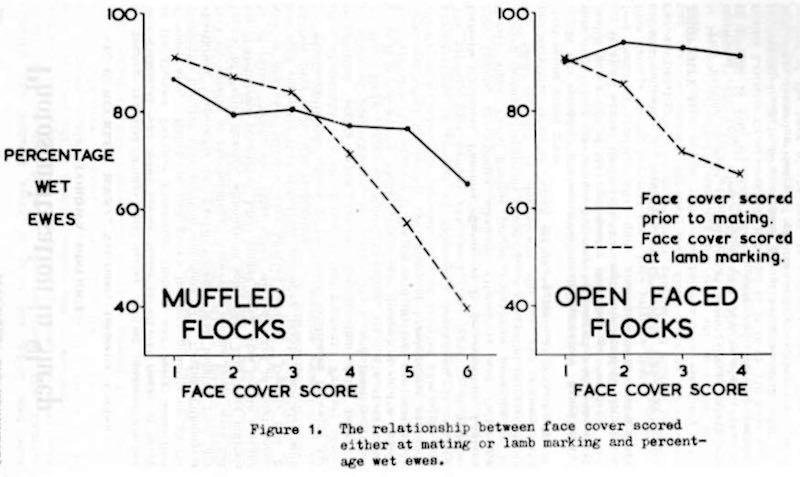
These results enable a striking clarification of the variable results recorded in the literature. As previously discussed, papers were located where ewes had been scored for face cover prior to mating and where incidence of wet ewes had been recorded. Percentages of wet ewes averaged over the seven sets of data were 88:88:83 for the open, intermediate and muffled portions of the flock respectively. The reduced fertility of muffled ewes, though slight, was recorded in all experiments and is in agreement with the significant, though small negative regression obtained from our muffled flocks. In the three experiments where face cover was scored at marking time, the average trend was 78:66:37. It is tempting to conclude that in this case also, the big difference in wet ewes was produced by the influence of fertility on face cover.
Our provisional conclusions are therefore that:
1. A reduction in wet ewes is a problem only with muffled grades five and six. Obviously, face cover is of little predictive value when a lambing record is already available.
2. When surveying face cover influence, care must be exercised to score at mating time, if false estimates are to be eliminated.
As well as recording wet ewes at lamb marking, it was possible to subdivide this group into ewes with lambs at foot and those which had lost their lambs. The results were as follows:
| Face Cover Grade | |||||||
|---|---|---|---|---|---|---|---|
| 1 | 2 | 3 | 4 | 5 | 6 | ||
| Muffled Flocks | Lactating | 85 | 68 | 72 | 68 | 67 | 60 |
| Lost Lambs | 6 | 14 | 11 | 12 | 13 | 12 | |
| Open Flocks | Lactating | 78 | 77 | 78 | 71 | ||
| Lost Lambs | 14 | 19 | 16 | 23 | |||
In the case of the open faced flocks, some increase in lamb mortality is noted with increasing face cover, although in general any fertility difference can be ascribed largely to wet ewes. This is to be expected as twinning percentage would be negligible.
Results to date therefore point to reduced conception rate in muffled ewes only, whereas ovulation rate and lamb losses may show more even trends in relation to face cover. Thus to mention the extreme situations:
| Open faced flock | No face cover — fertility association (Cunnamulla) |
| Low twinning percentage | |
| Low lamb losses | |
| Muffled flock | Marked face cover — fertility association (Trangie) |
| High twinning percentage | |
| High lamb losses |
It is hoped that this suggested pattern can be confirmed by current experimentation.
References:
- Terrill, C. E, (1949) — J. Anim. Sci., 8: 353
- Young, S. S. Y., Turner, H. N. and Dolling, C. H. S. (1963) — Aust. J. Agric. Res. (in press)