
ARCHIVE FILE
This article was published in 1960
See the original document
INSTITUTE OF INSPECTORS OF STOCK OF N.S.W. YEAR BOOK.
Acetonaemia in Dairy Cattle
Artis Medenis, V.M.D. (Riga Univ.)
In this paper it is proposed to discuss only the following aspects of acetonaemia:— (1) the etiology, and (2) the ways of treatment and prevention of this condition.
The etiology is fully understood only when we take into consideration the ruminant mode of digestion of foodstufts. In omnivora (man, pig) and in carnivora (dog. cat,etc.) the digestion process is carried out entirely by the enzymes of the body juices. In herbivora, which are the only animals digesting cellulose, the digestion process is based on different principles. For example, in ruminants the digestion is carried out in the forestomachs by micro-organisms: protozoa and special rumen bacteriae.
All carbohydrates such as cellulose, starch, sugars,etc., and even glucose (the last normally in other animals is absorbed into blood stream directly) are split by these bacterial enzymes to the end products of ruminal carbohydrate digestion - the lower fatty acids:—
67% acetic acid
19% propionic acid
14% butyric acid.
Only a very small portion of glucose is carried directly into the abomasum.
These three fatty acids are absorbed by the intestine wall into the blood stream. As the liver is the main organ in which the carbohydrate metabolism takes place, they are carried to the liver for further treatment.
The liver forms and stores glycogen, which is the source of energy for muscles, brainetc. Glycogen is formed from two sources:—
(1) via glycogenesis from carbohydrate material; such as glucose,
(2) via glyconeogenesis, when glycogen is formed from non-carbohydrate sources; such as glycerol, lactic acid, pyruvic acid, propionic acid and many other simple substances. These are called glucogenic substances.
The liver can store only a limited amount of glycogen. Therefore, in cases when there is a shortage of food and the glucogenic substances, there is not enough building material for synthesis of glycogen and the organism turns for help to its own depots; such as body fat.
When required, liver glycogen is split up to glucose and transferred in this form to body tissues (muscles, brain,etc.) where energy is needed. The muscles also can store for their own use a certain small amount of glycogen.
Of the three fatty acids produced in the rumen, only the propionic acid (containing an odd number - 3 C atoms) is glucogenic. Two other acids can be utilised by the liver for body energy production only when there are enough glucogenic substances in the liver to promote the hepatic oxidation of these fatty acids. In this oxidation cycle the main substance is oxalo-acetate, and in the absence of oxalo-acetate these reactions cannot take place. Oxalo-acetate acts like a catalyst in the following important metabolic cycles: (1) citric acid cycle, in respiration of oxidation process; (2) tricarb-oxylic acid cycle: which shows how fatty acids and amino acids are used for energy production; and (3) important part in fat metabolism for energy production. The precursors of oxalo-acetate are glucogenic substances, such as glucose, glycerol, propionic acid,etc., and when due to shortage of glucogenic substances the liver is not able to oxidise for energy production the two fatty acids (acetic and butyric), the latter are changed to ketone bodies:
(1) aceto-acetic acid
(2) B-hydroxybutyric acid and
(3) acetone.
The first two acids are not toxic, but acetone is toxic to body tissues. Acetone is always an end product; the two acids under certain circumstances can be changed back to acetic acid.
The ketone bodies cannot be used by the body and therefore are excreted through kidneys, lungs, skin glands and with milk. Acetic and Butyric acids are ketogenic in their character; propionic acid is glucogenic.
Ketone bodies tend to be formed when glucose or glucogenic carbohydrate metabolites, such as propionic acid, are in short supply: and in consequence there also is a shortage of oxalo-acetate, which in turn creates hypoglycaemia in the body. This means that hypoglycaemia is associated with ketonemia. In fattening cattle acetic and butyric acids are fat formers, and in reverse, when body fat is used by the animal for energy production, the fat is split to glycerol and these two fatty acids.
What are the reasons for the cow becoming ketotic? High milk yield takes out of the system a lot of carbohydrates in the form of lactose. This lowers the quantity of available glucogenic substances and the shortage of these substances leads to a shortage of oxalo-acetate. As a result of this latter shortage the acetic and butyric acids, produced in the rumen or when the body fat is split, cannot be oxidised for energy and are converted to ketone bodies, which are then excreted. This is the reason that acetonaemia is newly calved cows; symptoms appearing mainly during the second week after calving. The consequences are that the ketotic cow loses appetite and develops ruminal stasis; following which resistance is lowered, and ketosis becomes worse and worse. The animal is then unable even via glyconeogenesis to build up glycogen because a state of starvation sets in. The animal then has to start to use the body fats, which are carried to the liver and split to glycerol and fatty acids. Glycerol is synthesised readily to glycogen and so supplies energy, but the fatty acids, due to the fact that there is still a shortage of glucogenic substances cannot be oxidised for energy production and are excreted as ketone bodies. This in turn makes the ketotic situation worse.
In addition, or as a primary condition, there can be some other causes of Ketosis:—
(1) An excess amount of butyric acid in food; as in the case of bad silage.
(2) Varying the diet can affect the production of fatty acids in favour of ketogenic ones.
(3) Ketosis can develop when an animal develops a disease or in other conditions of stress. It is a fact that most diseases increase the energy requirements and in doing so the organism has to use up more glucogenic substances; leaving the ketonic substances in excess, and at the same time the decreased intake of glucogenic substances causes the increase of ketogenic metabolites. The writer never has seen ketosis in bulls or dry cows, or in cows in late lactation; even in cases of severe disease. It is thought that the explanation for this lies in the fact that there is no extra drainage from the body of glucogenic substances through milk production, and the animal is then more able to organise all available glucogenic substances in order to throw off the ketotic dangers.
When the ketotic situation reaches dangerous proportions in quantity of ketone bodies, the animal then throws into the fight to save it from this situation the Pituitary-Adrenal system; resulting in the release of ACTH and adrenocortical hormones, which then promote glyconeogenesis from protein sources. The same hormones also are responsible for increased use for energy production of depot fats. As a result of this hormone action the hypoglycaemia starts to disappear and the amount of glucose in the blood increases.
In ruminants the protein in the food is of importance to rumen bacteriae. The proteins of food are split by bacterial enzymes, and nitrogen from food protein is a basis for synthesis of bacterial plasma protein. About one-third of the dry mass of forestomach contents is made up of bacteriae and other micro-organisms. These micro-organisms eventually are moved further to the abomasum, and the juices of the abomasum and intestines split the bacterial proteins to amino acids. Nitrogen in Urea, which is an inorganic substance, can be utilised for protein production by rumen bacteriae, and therefore urea often is mixed in concentrates. The amino acid are building stones for new body cells. But in an emergency protein can be used also for energy production in the form of amino-acids.
It is known that the non-essential animo-acids such as glucine, alanine, glutamic acid,etc. are glucogenic and therefore very well tolerated by the organism for energy production. They also can be useful as precursors of oxalo-acetate in oxidation process of ketonic acids. The essential amino-acids are mainly ketogenic, but due to their indispensability they are used for body production as a last resort only.
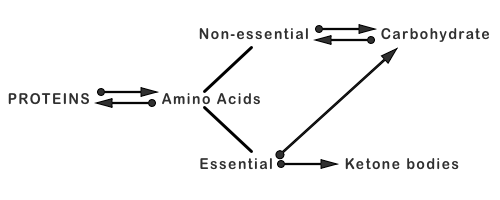
The adrenocortical hormones, so-called Glucocorticoids, promote glucogenic activity in forming the glycogen mainly from protein sources from the amino-acids, when the carbohydrates are not available or cannot be utilised due to shortage of glucogenic substances, and so increase the glucose level in blood with all glucogenic consequences. Shaw (1947 and later) considered that ketosis is a result of adrenocortical insufficiency and his belief was that by stimulating adrenocortical secretion one would derive the ketotic condition.
But now the latest idea is that the hormonal insufficiency is not the main factor; and certainly not the cause of most cases of ketosis, since it is not likely that mobilisation of body depot fats in ketotic cows could take place in the absence of glucocorticoids (3). As a matter of fact it has been demonstrated that blood levels of hydrocortisone are higher in ketotic cows than in normal animals (2).
Liver damage or injury from toxins can be a predisposing cause of ketosis. Liver fluke infestation was seen on one farm; when 12 cows purchased from another district known as heavily fluke infested, suffered from ketosis and emaciation after calving. They did not respond very well to the usual ketosis treatment, but after drenching with Hexachlorethane the general health of these 12 cows improved tremendously and ketotic symptoms disappeared. Ketosis itself develops in most cases some liver damage (sic) without any outside cause; due to the fact that in the later ketosis stages depot fat is mobilised in the liver, causing so-called "fatty liver" and liver degeneration. This condition, in turn, is responsible for inability of the liver tissue to neutralise poisonous substances. The death of untreated ketotic cows (death is very rare) is due mainly to liver damage from self-intoxication.
When proteins are used for energy production they leave some poisonous nitrogenous substances, which normally are neutralised by the liver. But when the liver is damaged extensively these poisonous substances intoxicate the organism and make the ketotic condition worse.
In actual practice, the writer had the following numbers of treatments during the past 4 years:—
| Year | Total | Jul | Aug | Sep | Oct | Nov | Dec | Jan | Feb | Mar | Apr | May | Jun |
|---|---|---|---|---|---|---|---|---|---|---|---|---|---|
| 55/56 | 226 | 5 | 5 | 11 | 8 | 2 | 3 | 2 | 5 | 1 | 51 | 84 | 49 |
| 56/57 | 543 | 53 | 31 | 34 | 1 | 2 | 3 | 17 | 41 | 41 | 133 | 86 | 101 |
| 57/58 | 363 | 104 | 65 | 42 | 18 | 7 | 7 | 1 | 5 | 20 | 19 | 42 | 23 |
| 58/59 | 321 | 43 | 27 | 34 | 7 | 2 | 4 | 5 | 9 | 49 | 88 | 29 | 24 |
| (Summer months; low number of cases) | |||||||||||||
This diagram clearly shows that the worst months for acetonaemia on the South Coast of N.S.W. are March to September (incl.), when the grass is old, fibrous, and low in proteins; while the spring and early summer months, when the grass is young and protein-rich, are very free of acetonaemia. During a general drought period the numbers of acetonaemia cases increased very much (Feb. 57 to Aug. 58).
Comparable figures for Winter and Summer months:—
| Year | Total | 7 Winter months | 5 Summer months |
|---|---|---|---|
| 55/56 | 226 | 206 | 20 |
| 56/57 | 543 | 479 | 64 |
| 57/58 | 363 | 315 | 48 |
| 58/59 | 321 | 294 | 27 |
These figures show that during periods of hand-feeding and poor pastures the digestion process is not following the normal pattern and there is a certain lack of glucogenic substances. In a good milking cow the result is ketosis. In an average or a bad milker the above mentioned adverse factors are without effect, due to the ability of the cow to decrease the milk yield; so stopping the drainage of glucogenic substances. And so, instead of milk production, this type of cow starts to build up body fats and fattens up; since there is plenty of carbohydrates in the food available.
During the summer months, when grass is rich in proteins, there is plenty of building material for glucogen production from protein sources alone.
Following the lines of the above facts, the writer tried on one farm, where ketosis has been a herd problem for the last 4 years at least, a change of diet to higher protein content from 14 per cent. to 18-20 per cent. crude protein and the subsequent response showed that Ketosis tended to disappear, or to occur in a mild form only. On this same farm, where the origin of ketosis seemed to be in an improperly balanced ration, there was little response to glucocorticoid treatment; comparable to a single glucose injection only.
One's own experience has been that only the high producing cows are subject to Ketosis. The high producer still will give milk despite the ketotic state in the liver. Only when nearly at starvation state does such an animal tend to cease milk production. A low producing cow gives up milk production at an early stage of ketosis and with decreased milk production the ketotic condition practically disappears. Therefore, when treating ketotic cows, it helps very much if they are not milked completely out for several days.
If not treated, the ketotic cow follows nature's way of curing - goes dry but if treated gives an excellent production figure during that lactation; provided, of course, that there are no complications such as liver damage,etc. The cow gone dry due to untreated ketosis seldom comes back to full production.
Ketosis tends to appear more in certain blood lines. The writer is of the opinion that there is not any degree of inheritance of ketosis, but that there certainly is an inheritance of high milk production; and so a predisposition of certain high producing blood line cows to ketosis. One has seen very often that all daughters of a certain cow which is subject to ketosis every year are also affected, but all are also excellent producers.
What are the methods of treatment? As the direct cause of ketosis is deficiency of glucogenic substances in the liver to oxidise the ketogenic fatty acids, the logical answer is to administer glucogenic substances:
(1) Glucose. Can be administered parenterally only, because if drenched is split in the rumen by bacterial enzymes to lower fatty acids. As four-fifths of these are ketogenic (acetic and butyric) acids, drenching can be of very little assistance. But when administered intravenously, glucose is 100 percent. available for oxalo-acetate production and glycogenesis. Oxalo-acetate in turn takes part in the oxidation of ketogenic fatty acids, and so the ketone body formation is stopped.
In the writer's practice, the i.v. glucose treatment is the standard one, giving the best results for the cheapest price. The smallest dosage used is: 16 oz. of glucose powder in 40-50 per cent. solution for a big cow (A.I.S., Friesian), and 12 oz. of powder for the small animal (Jersey, Guernsey). It is found that a smaller dose never gives as good results. 20 oz. doses have been tried in some cases, but have proved to be too much at once, sometimes upsetting the cow. It would be preferred to give smaller doses more often, but as that would increase the treatment costs beyond the reach of the average farmer, we have to use larger doses and inject every two, or at most every three days until recovery. The average cases are cured completely after two treatments, but bad cases need several injections.
The glucose treatment can be followed up with some other glucogenic substances which can be used as a drench:—
(2) Glycerol (glycerine). When drenched is not split in the rumen, but is carried in full strength to the intestines and there split to glucose; and in the form of glucose absorbed through the intestine wall.
(3) Propionic Salts. Can be used as a drench. They release propionic acid, which is glucogenic.
(4) Propylene Glycol, which is also a precursor of glucose, is not split in the rumen; and consequently also can be given as a drench.
But these three substances do not give immediate relief, and when used in needed quantities can be quite expensive. Therefore, it is advisable to use these as supporting treatment to glucose injections.
The opinion is that it is a bad policy to rely on the owner's treatment by drench (glycerol, propionic salts or propylene glycol) without consulting at first the veterinary surgeon, because of the fact that ketosis can be associated and aggravated by some secondary illness; such as metritis, chronic indigestion,etc., or by some pathological state of affairs (Traumatic reticulo-peritonitis,etc.). It has been found in practice that about 25 per cent. of ketosis cases have secondary complications which aggravate the ketotic condition, and that these cases respond much quicker to the treatment if the accompanying illness is treated at the same time.
The treatment of choice is i.v. glucose repeated every 2 or 3 days; supported by a glycerine drench - pint of glycerine every 12 hours, until recovery is complete.
In diagnosis the "Acetest" tablets have been found very reliable. The deepness of the pink colour can be a guide to quantitative test of the ketone bodies in the urine.
Early diagnosis and prompt treatment gives better results. Early treatment saves a lot in milk production. It is advisable to leave Acetest tablets with the owner to test his suspicious cows (about 90 per cent of cows let a few drops of urine following rubbing of the perineum) to enable him to organise veterinary help at the earliest date.
As the muscles and the brain are dependent for their energy production on glycogen, in ketotic cows, when there has developed a shortage of glycogen, these two types of tissue will suffer first. As a consequence the ketosis may show a so-called nervous type; due to an insufficient quantity of oxygen in the brain tissue the cows become nervous, excited, sometimes even charge and later become stupid,etc. Very often muscle fibres do not get sufficient feeding and the lactic acid accumulates, resulting often in ketotic cows with stiff or bent neck, stiff legs,etc.
After administration of glucose substances the nervous or muscle symptoms of the ketotic cow disappear completely. One does not agree that the division into nervous and digestive type of ketosis is justified; rather that the symptoms are due only to a milder or an advanced form of ketosis, or due to the fact that in some cows the "locus minoris resistentiae" is the nervous system, in others the musculature. In others, due to an impaired liver, the fatty hepatic degeneration is more evident.
In many cases it has been found helpful to drench with small amounts of sugar (preferably brown) and molasses, although these are split to the lower fatty acids, but a small percentage of brown sugar and molasses may go through the forestomachs unchanged. Nevertheless, the 19 per cent. propionic acid produced helps the glucogenic process. Only when drenched in too great quantities do these two remedies tend to acidify the forestomach contents and result in decreased bacterial activity. Small quantities of sugar and molasses can be of value also for rumen bacteriae to draw their energy supplies. In ruminants a huge quantity of saliva is produced, but ruminant saliva does not play any part at all in the digestion process; the only function of saliva being to regulate the pH in the forestomachs.
During the last decade the hormones of the pituitary gland (ACTH) and of the adrenal cortex (glucocorticoids) have been tried widely in general practice in the treatment of ketosis.
ACTH is a natural product of the pituitary and promotes the production of adrenocortical hormones, called glucocorticoids. Cortisone and hydrocortisone both are natural glucocorticoids, but lately produced also as pure synthetic substances. During the last 3 years two new synthetic glucocorticoids - prednisone and prednisolone have been used widely. Both are much stronger than cortisone and hydrocortisone. But all these substances have a comparatively short duration when injected. Therefore, recently there has been a trend to develop longer acting glucocorticoids, and one, "Vetracortenol" - an ester of prednisone, shows prolonged action.
The treatment value of glucocorticoids for ketosis is based on their glucogenic activity, but as they are relatively expensive and the effective action is not longer than a couple of days, it is economical to use them in severe cases, or for valuable cows, only.
On farms where ketosis is more or less a herd problem due to improperly balanced ration, the result of ACTH or glucocorticoid treatment is not promising and not economical. The main aim in these herds must be to rectify the ration. Where only an occasional animal becomes ketotic, ACTH and glucocorticoids give good results.
However, the glucocorticoids may contribute to the recovery of the sick cow for a different reason. They produce a feeling of wellbeing and stimulate appetite; while their anti-inflammatory action relieves pain,etc. When the factor precipitating ketosis is of a transient nature the glucocorticoid treatment will be successful, but relapses will occur if the cause is a persistent one (4).
The dose rates recommended are:—
500 mg. Cortisone; 200 mg. Hydrocortisone; or 100 mg. Prednisone or Prednisolone.
The darkest field in the Acetonaemia problem is - how to prevent it; an especially serious problem when acetonaemia occurs on a herd basis. As was mentioned previously, the treatment of Liver Fluke, increased protein in the ration, and/or ample green pasture certainly can help. Especially recommended is a mineral and vitamin-rich diet to improve the general health of the cows and so increase resistance against diseases. It is not yet known whether the trace minerals play a direct part, but certainly a trace mineral deficiency would be a predisposing factor due to lowering of resistance.
There have been farms with an acetonaemia problem every year, and as far as could be observed clinically such preventive measures as higher mineral and vitamin diets and richer protein feeds still did not eliminate the disease; though the form was much less severe in most cases.
References:
- Baldwyn, E. — "Dynamic Aspects of Biochemistry". Cambridge Press, 1949
- Robertson et. al. — Proc. J. Dairy Sc. June, 1955
- Dye, J. A., et. al. (1953)- Cornell Vet., 43 : 123
- Adler, J. H. & Dye, J. A. — J. Am. V. Ass., April, 1957; page 293
- Pearson, W.R. — "An Introduction to Biochemistry", W. Heinemann, London, 1948