ARCHIVE FILE
This article was published in 1953
See the original document
INSTITUTE OF INSPECTORS OF STOCK OF N.S.W. YEAR BOOK.
HINTS AND GADGETS
G. CHARLES. B.V.Sc., Inspector of Stock, Forbes.
The following few notes are not compiled with a view to extolling the virtues of the articles and practices described, but in the hope that others may find them useful.
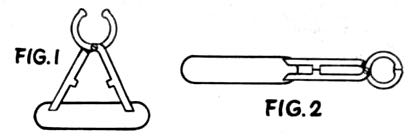
1. Cattle Bulldogs. The usual type of bulldogs is purchased fitted with a length of cord passed through the shanks or handles and knotted at one end. When in use, the cord may break or the instrument open if pressure is released; and, in addition, owing to the arrangement of the cord, greater pressure is exerted to one side or another when the cord is pulled tight. To overcome these inconveniences, the cord was removed, the holes in the shanks made oval and a piece of 1-inch steel rod passed through the holes, bent and welded into an oval 7 inches long and 11 inches wide internally at either end. (Fig. 1). To use the bulldogs so fitted, they are opened along the long side of the oval, put into position, closed and then locked by turning the oval until one or other end is through the shank holes. (Fig. 2). The bulldogs are thus locked in position and even if the cord breaks they will not open. Even pressure is exerted on both nostrils and a straight pull is possible.
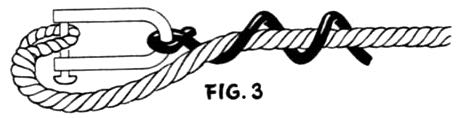
2. We have all experienced the awkward moment when a knot jams, or the difficulty of untying knots when wet or under strain. To overcome this, the following article has been used with success. A small iron shackle. 2½ inches long and 1½ inches wide, with a threaded pin was obtained, and to it was attached, by a loop, a piece of 1-inch round iron which had been given 21 turns of spiral, like an enlarged corkscrew, the turns being about 1 inch interna1 diameter. To use this, one end of the rope is attached to the shackle, and the rope is then wound into the spiral, where it runs free in the centre. (Fig. 3.) It can be quickly released under any conditions by simply unwinding the rope out of the spiral. The loop always runs free under any conditions. Using this gadget, quiet cows have been bled by tying the head to one post, passing the loop around the neck and taking the rope along the cow's side, just below the hip, and tying to a second post. Used thus, it restricts the cow's movement and acts as a blood cord.
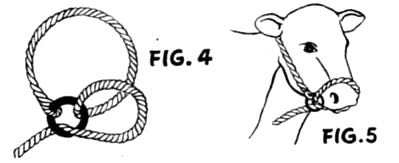
3. A length of 1-inch diameter rope with a 2-inch metal ring spliced in one end is very handy for a number of purposes. A simple halter for polled cattle can be made from it by passing a bight (sic) of rope through the ring to form 2 loops. (Fig. 4.) The larger loop goes around the head and the smaller one around the nose (Fig. 5.) Some restraint can be achieved by pulling the end of the rope.
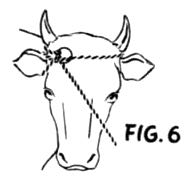
4. The same rope can be used as an ear-twitch in horned cattle. A loop is made and placed around the horns. The running end is ther passed behind the ear. around the butt, and passed under the standing part of the rope to form a half-hitch. The rope is pulled to apply restraint. (Fig. 6.)
5. In modern milking machine bails the division between two sets of bails generally has a sheet of metal spot-welded to the pipes at the head of the bails. This is often a hindrance when working on or about the head of a cow in the bail, and in several instances owners have, at my suggestion, cut the welds and fitted small brackets to the pipes and then attached the sheet with small nuts and bolts, thus enabling its removal when required. In this way work can be done on either side of the cow simply by putting her in the right or left hand bail and working from the other side.
In these same bails a length of 2-inch water piping has been fitted transversely above the bails, about 8 or 9 feet from floor level and above the doors. This is very useful for pulling the cow's head up for purposes of restraint.
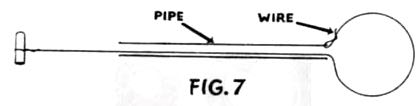
8. A handy pig snare can be made from a length of ½ or ¾-inch galvanised iron piping and a piece of wire clothes line. It had been thought that this instrument was well known, but several pig owners, to whom it was shown recently, had never seen it before; so it is described here. A piece of piping, 2 feet long, has a ¼-inch hole drilled in one side near the end. Through this hole is passed one end of the 4-foot length of wire clothes line and it is fastened there. The free end of the wire is then passed up the inside of the pipe and then attached to a 4-inch piece of piping as a handle A length of ¾-inch rubber hose may be forced over the top end of the piping to give a better grip. (Fig. 7.) To use this snare, a loop is made in the wire and this is passed over the pig's snout and pulled tight. A fair degree of restraint can be exercised with this instrument.