
ARCHIVE FILE
This article was published in 1946
See the original document
INSTITUTE OF INSPECTORS OF STOCK OF N.S.W. YEAR BOOK.
In the Horse Days
F. HILDRED, Inspector of Stock, Goulburn.
There is, perhaps, more than a tendency to-day to overlook the fact that the high-powered motor car is a comparatively very recent development; and that many Inspectors of Stock still very much on the active list have vivid memories of a very different means of transport. Before, and for several years after the advent of the motor car in the early nineteen hundreds, Inspectors travelled by horse-drawn vehicles; the type of vehicle and the number of horses varying in different Districts.
The turn-out most favoured was a light Abbot buggy and a pair of horses; these vehicles being very fashionable then and used regularly by landholders and station managers. In some Districts, especially in the Coastal and closely settled areas, a sulky with one horse was popular. In wet weather and on heavy roads an outrigger sometimes was attached and an extra horse harnessed up. but owing to the uneven pull this type of turn-out was not favoured very extensively.
In the larger Western Districts some Inspectors used a pole sulky and a pair of horses and this type of turn-out had many advantages. It was light to draw; having only two wheels and a central pole the draw was even. It was very useful in wet weather, particularly on the black soil plains where the going was heavy. It was a splendid turn-out when long distances had to be travelled, especially on the plain country but was not suitable for hilly country.
It was necessary in those days to keep several harness horses, and, in addition, some Inspectors kept one or two hacks. In odd Districts a pack-horse also was used. In the Western Districts horses generally were worked off the grass and not stable feed. In many Districts it was practically impossible to obtain horse feed apart from the natural grass, but the distances these grass-fed horses could travel, if properly handled, was remarkable. Many of them were never shod; the hooves being kept trimmed with a chisel and rasp.
In Western Districts the Inspector's horse paddock usually was the Town Common. Some of these Commons were thousands of acres in area and horses, when required, had to be run into a yard to be caught.
Great care was taken to secure a pair of horses which travelled fairly evenly together. Either a pair of free horses or a pair of lazy or slow ones was required. If a pair were evenly matched it made a great difference when travelling.
Horses frequently were lost for days or weeks at a time. Shortage of feed and water were also problems to be dealt with. When on a journey it was often necessary for horses to be watered and then driven several miles further on to where grass was available.
As would be expected. Inspectors using horses had to camp out very often, and many camps were made at Back Stations, Boundary Riders' Huts, and Tank Sinkers' Camps. It was not altogether uncommon to be lost temporarily; this being brought about by taking wrong roads, or short cuts across country.
When horses were turned out at the end of the day it was customary to put a bell on one and, of course, quite frequently the horses were hobbled to prevent them from straying away during the night. It was always a welcome sound to hear the bell in the morning and know the horses still were within reach.
The hospitality of the landholders was splendid. When the Inspector arrived at a homestead the horses were turned out into the horse paddock and run up to the yard any day they were required.
The following may be taken as typical cases of Inspectors using horses in the early days:—
Frank Madden, of Milparinka, used a buggy and pair; he kept three pairs of buggy horses, two hacks and a pack horse. It was a familiar sight to see him with his team yoked up in his light Abbot buggy ready for a trip out to the Queensland Border Crossing places. Fresh horses, water bag and tins filled, tucker box under the seat, hobbles and horse bell, quart pot, a couple of blankets and tent fly completed the load. Occasionally he carried a saddle and took a hack with him.
In my own case, when stationed at Ivanhoe, a pole sulky and a good pair of nuggety ponies (about 14 hands) were preferred. The outfit included four pairs of ponies and a hack.
The travelling equipment always was owned by the Inspector and not provided by the Board. Before the first Stock Inspectors' Award came into operation, an equipment allowance was made to the Inspector. This varied to some extent in different Districts and usually was the result of mutual agreement between the Board, the Department and the Inspector. When the Award became operative provision was found in it to cover equipment allowance.
The change from horses to motor cars was very gradual; as owing to lack of mechanical knowledge by Inspectors, bad roads (none at all in places) and unreliable cars, they were not favoured. George Johnston, at Broken Hill, was the first Inspector to use a car on official duty — in 1913. Other Inspectors gradually followed his example — E. Reuss, Cobar, in 1916; J. N. McCulloch, at Balranald, in 1921; Jim Johnston, at Wilcannia, in 1922: and Keith Ryan, at Walgett, in 1922.
From then on the horses gradually went out and motor cars now are used by all Inspectors; some being owned by the Inspector concerned, while in other cases they are provided by the Board.
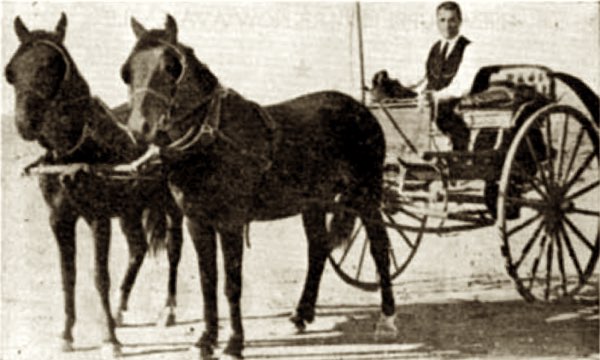
F. Hildred, Inspector of Stock, Ivanhoe.