
CASE NOTES
SPONTANEOUS VAGINAL RUPTURE IN MULTIPAROUS LATE PREGNANT FIRST CROSS EWES
Bruce Watt, Tablelands Livestock Health and Pest Authority and Andrew Denman, Blayney Veterinary Hospital
Posted Flock & Herd March 2007
Introduction
In March 1961, JB White wrote to the Veterinary Record asking colleagues if they could shed any light on a peculiar condition - seen this season in heavily pregnant ewes. He reported that ewes on three separate farms had prolapsed their intestines through a tear of the vaginal wall. White suspected sadism initially but rejected this possibility after farmers reported the problem on three different farms 25 miles apart. A number of correspondents replied that they had seen the condition. JA Watt from the Edinburgh School of Agriculture replied that he first saw it in 1952 and that shepherds were aware that it had occurred over at least the last 50 years. He had also seen 14 outbreaks this year. Watt considered that mature ewes of the larger breeds bearing twins and triplets were most frequently affected. He further suggested that spontaneous vaginal rupture occurred because the gravid uterus stretched the vagina over the pelvic floor rendering it susceptible to rupture and subsequent prolapse of the intestines. He noted that these vaginal tears usually occurred in the dorsal vaginal wall and were accompanied by profuse haemorrhage and rapid death.
Andrew Hansen and John Plant (1980) described a spectacular case west of Orange in a mob of very fat 4-6 year old first cross ewes lambing in 1979. Of 320 ewes in the mob, 70 died from spontaneous vaginal rupture. While a 'Borenore bugger' (Hansen pers comm.) was first suspected, these authors concluded that 'the condition was due to the weight of the uterus drawing the vagina tightly against the floor of the pelvis, as suggested by Watt (1961).'
CASE 1
A prime lamb producer from the Blayney district who normally runs 1500 first cross ewes reported that 22-23 mature ewes had prolapsed their intestines through the vagina about a week before lambing. Most cases were in ewes bearing multiple pregnancies and occurred prior to and not associated with parturition. The owner observed several ewes that abruptly (almost explosively) ruptured their intestines through the vagina as he moved them. The owner commented that he first saw this problem in 1970 when it occurred under similar circumstances. Since 1970, he has seen it sporadically but normally only 2-3 ewes per year were involved. Affected ewes died soon after their intestines prolapsed and were often found dead. A mature first cross ewe in fat condition (CS 4.5) was autopsied on 29 June 2010. The ewe was dead in lateral recumbency with loops of bowel partly stripped from the mesentery and the caecum prolapsed through a 3-4 cm tear in the dorsal vaginal wall. The ewe was bearing large almost term twin lambs.
CASE 2
An experienced and observant prime lamb producer from the Blayney district, this year lambing 800 twin bearing and 300 single bearing first cross ewes commented that he has seen 60 cases of prolapsing intestines and death (spontaneous vaginal rupture) this season. He commented that it has been the most significant cause of ewe mortality in his ewes this lambing. Most cases occurred in a mob of older twin bearing ewes in fat condition. This producer in conversation with neighbouring farmers found that several others have seen occasional cases this year.
CASE 3
The manger of a property near Rockley on the central tablelands reported two cases of intestines prolapsing prior to lambing in two of 580 first cross ewes in very good condition. An affected ewe was autopsied on 3 August 2010. The ewe a mature first cross in fat condition had died suddenly after prolapsing both intestines and caecum prior to lambing. On post-mortem, a tear 4-5 cm long was located in the dorsal wall of the vagina through which the intestines had prolapsed. There were several large blood clots within the peritoneum and the carcass was pale suggesting blood loss. The ewe was carrying near full term twin foetuses. By the end of lambing 5-6 ewes had died of spontaneous vaginal rupture.

Case 3. Intestines and caecum prolapsed through a spontaneous rupture of the vaginal wall

Case 3. Clots of blood within the peritoneum and twin foetuses
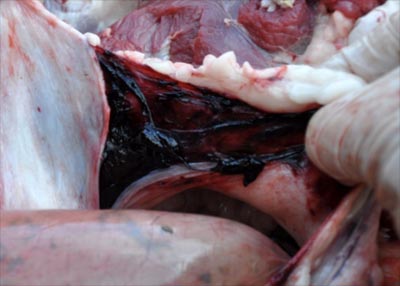
Case 3. Tear in the dorsal wall of the vagina
Discussion
DC Knottenbelt (1988) reported on 17 cases of vaginal rupture associated with herniation of the abdominal viscera seen during four years of general practice in Warwickshire. Affected ewes averaged four years of age (range 3 to 6), averaged 2.7 lambs per ewe and ranged from poor to fat condition. Three ewes were full term while the remainder were estimated to be up to two weeks pre-partum. He speculated on an association with vaginal prolapse. Knottenbelt also noted that serum calcium levels were slightly lower and beta-hydroxy butyrate levels slightly higher in affected ewes. This finding is not surprising and is likely to be a consequence of the disorder rather than a predisposing factor. G Mosdol (1999) also reported on seventeen cases seen in general practice, this time in Norway. He noted that affected ewes were in normal body condition, mostly carried twins and prolapsed about a week before lambing. He found no association with vaginal prolapse but reported a concurrent uterine torsion in four cases.
Spontaneous vaginal rupture is rarely reported in southern Australia. These cases and the case reported by Hansen and Plant suggest that is associated with mature crossbred ewes in very good condition and bearing multiple pregnancies. It may occur at low prevalence on many flocks especially in good seasons and on rare occasions can be a major cause of mortality in late pregnant ewes.
References
- Hansen AT and Plant JW (1980) Tearing of the vaginal wall with intestinal prolapse in pregnant ewes Australian Veterinary Journal 56:510
- Knottenbelt DC (1988) Vaginal rupture associated with herniation of abdominal viscera in pregnant ewes The Veterinary Record 122:453-456
- Mosdol G (1999) Spontaneous vaginal rupture in pregnant ewes The Veterinary Record 144:38-41
- Watt JA (1961) The Veterinary Record 73:357
- White JB (1961) An unexplained condition in pregnant ewes The Veterinary Record 73:281