
CASE NOTES
Hyperthermia as a possible cause of deaths during live sheep export
Greg Curran, Veterinary Officer, DPI, Broken Hill
Understanding the causes of death during live export
In reviewing the literature on mortalities in the live sheep export "Chain-of-Supply" (including Makin et al. (2010), Richards 1993, Higgs 1993, Richards 1989), deaths are reported in terms of 2 syndromes (enteritis; inanition) and one set of environmental conditions (heat stress, although not in the Richards or Higgs papers).
No specific cause or causes of these two syndromes have been determined, apart from "salmonellosis". Diagnosing "salmonellosis" in feedlots and on board ship appears to depend on finding gross pathology of enteritis. The evidence available from the above reports that deaths are due to "salmonellosis" is equivocal. Convincing evidence that the enteritis found during necropsy is solely due to disease processes resulting from infection by virulent salmonella species is generally not presented or not available.
The following statement illustrates the rationale used: "While it is possible to isolate salmonella from the mesenteric lymph nodes and gut contents of sheep that have not died of salmonellosis the gross pathology and concurrent isolation of Salmonella from a diversity of sites provides a strong causal association" (Makin 2010, p104). Epidemiologically and logically, if an agent that may cause a disease is found in both normal and diseased tissue, finding that agent is not sufficient to say that it has caused the pathology and the disease.
The inappetence and inanition seen during live export has been related to "salmonellosis" (for example, Makin 7.6.2, 7.6.3). Salmonellosis and inanition are said to "remain the most common causes of mortality in the live sheep trade" (Makin 7.6.3). The evidence that infection by virulent Salmonella species causes inanition is circumstantial only.
No set of criteria (gross pathology, histopathology) have been sighted when sheep deaths have been ascribed to "heat stress". A diagnosis of "heat stress" appears to depend on finding dead or dying sheep when in conditions of high humidity and heat, rather than meeting pathological criteria at necropsy or in laboratory tests, or clinical criteria.
One conclusion available from a review of the literature is that infection with salmonella is believed to be the single most important cause of both enteritis and inanition, apart from pathology related to "heat stress".
No demonstration or proposed relationship between "salmonellosis" and heat stress has been sighted
Hyperthermia as a disease process
The veterinary and medical professions have had considerable success in understanding and managing infectious and toxic disease. The medical profession, by comparison, are more advanced in understanding and dealing with disease related to environment: for example, over-nutrition, inactivity, smoke inhalation, and heat stress.
In understanding heat stress, medical researchers have used animals as well as humans to understand the processes stemming from heat stress, which are usually termed hyperthermia (or heat stroke) reflecting the rise of temperatures in the body or locally in organs and tissues; the cellular and molecular consequences of these temperatures; and consequent disorders of cellular and organ function.
Key findings from medical research that have some relation to mortalities and pathologies observed during sheep export are that hyperthermia leads to specific pathologies (various authors); can lead to death of humans (Lim 2006, various authors), especially with high humidity and temperature, and prolonged exercise; affects the gut wall and nervous system more than other organs (various authors); leads to necrotizing enteritis-like lesions, initially of villi then of crypts, which increases permeability of intestinal wall to endotoxin (Shapiro 1986, Hall 2001), and leads to splanchnic vasoconstriction, reducing intestinal perfusion, and hypoxia. Hyperthermia can lead to cerebral ischaemia, and chronic neuronal death (Sinigaglia-Coimbra 2002, various authors); reduces myocardial contractility (Berkowitz 1972); can lead to reduced appetite (various authors); can affect the immune system (Lim 2006); can affect kidney structure and function (various authors); affects metabolism and physiology (Leon 2010, various authors).
Susceptibility to heat stress
Individuals vary in their core body temperature (BT - see McCrabb 1993); some have consistently lower BT; some have consistently higher BT than others. Sheep have generally higher BT (mean 39.5oC various authors) than humans and other animals, and have more limited means of dissipating excess body heat, as sheep lose body heat by evaporative heat loss through respiration, rather than sweating available to other animals and humans. Evaporative heat loss is less effective in high humidity (see Thwaites, Stockman). Susceptibility to hyperthermia varies between individuals: some are affected under relatively low heat stress, at low BT; others will resist high heat stress at higher BT; all are affected under prolonged, extreme heat stress or exercise (Hubbard 1977). Inflammation in the body increases susceptibility to heat stress (Lim 2006).
Given these observations, and that BT alters mammalian physiology about and over 40oC, sheep may be more susceptible to heat stress than other livestock and humans. This may be exacerbated if an individual has higher core BT than those with lower BT, is enclosed in spaces with high humidity and temperatures, such as on trucks with excess urine, or if sheep are wet, or on board ships with evaporative air cooling/ poor airflow/high ambient humidity and temperatures. Sheep may also be more susceptible if they have pre-existing inflammation from trauma or infection or toxicity or other disease or parasites contracted during trucking or in feedlots, or from inflammation acquired at prior links in "Chain of Supply"
Possible relationship between hperthermia and 'salmonellosis'
Makin (2010) reports that "Typical lesions of salmonella enteritis include loss of intestinal villi, infiltration of the lamina propria with inflammatory cells, micro thrombi and crypt abscesses". Images typical of sheep with salmonellosis were given and are shown below. No Salmonella are demonstrated in these lesions.
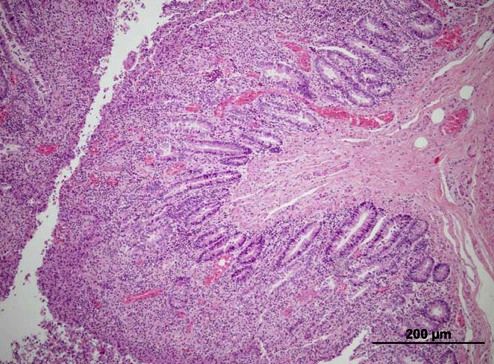
Low power view of intestinal segment showing loss of villi, microthrombi and infiltration of inflammatory cells
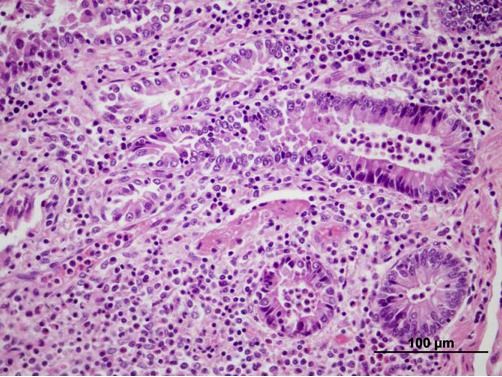
High power view of intestinal segment showing crypt abscess
These descriptions and lesions are similar to those reported in medical journals as being caused by hyperthermia, such as Fajardo (1984): "loss of epithelial cells in crypts and villi .... necrosis of epithelial cells of both villi (first) and crypts (later), with cessation of mitotic activity, authors observed an all-or-none effect; either the crypts were well preserved, with dividing cells, or the crypts were totally necrotic. Oedema was noted, immediately after cessation of hyperthermia."
Toth (1993) provides images of enteritis lesions resulting from experimental induction of hyperthermia that show similar range of changes to those reported in Makin.
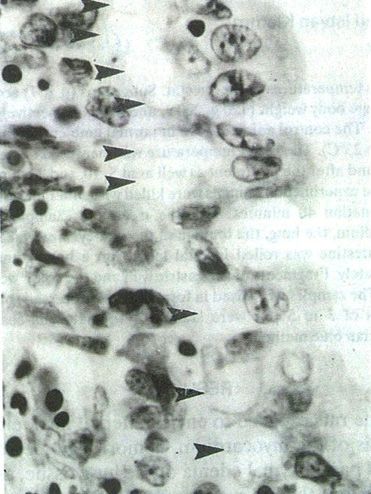
Image A. Subnuclear vacuolization of absorptive cells of SI
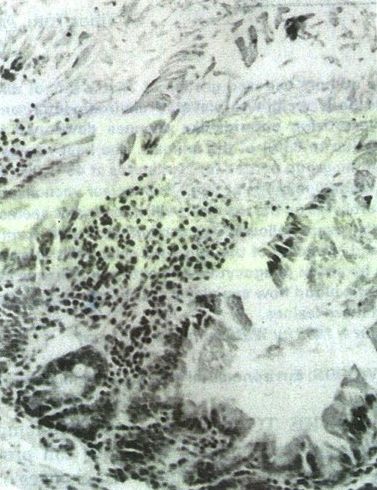
Image B. Epithelial shedding and autolysis of stroma of villus intestinalis
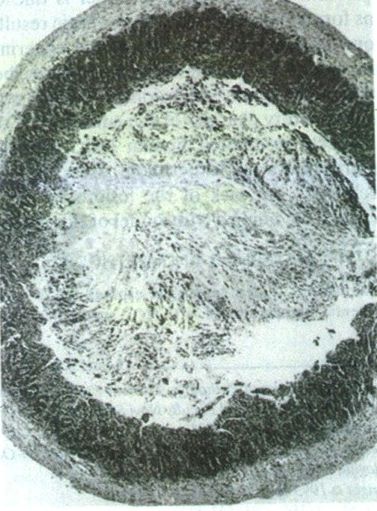
Image C. Fully developed lesion of SI after heat exposure: villous structure is lost; lumen filled with shedded cells and debris.
No attempt has been made in veterinary reports on "salmonellosis" in export sheep to differentiate observed gross and histopathological lesions with those caused by hyperthermia. It is important to note that the early literature on live sheep exports does not recognise mortalities due to heat stress.
It appears possible that hyperthermia will be a component in sheep mortalities seen during live export. It is important to either rule in or rule out hyperthermia as a component of mortalities in sheep, now that "heat stress" has been recognised in the veterinary literature on export sheep deaths.
Hypothetical relationships between hyperthermia and export mortalities
If hyperthermia is part of the disease complex that leads to enteritis and inanition syndromes, and the disease now reported as "heat stress", then it will be important to propose a plausible aetiology, consistent with Bradford-Hill's postulates.
One hypothesis available is that HS with resulting HT plays a more central role in these mortalities than does primary infection by salmonella. This hypothesis would describe the pathogenesis of mortalities as shown below the Diagram below.

More general considerations from this hypothesis are that hyperthermia is likely to be the pathological condition directly associated with "heat stress" in export sheep. Hyperthermia has been recognised in human medicine as a central pathological mechanism dependant on a complex set of causal factors. From human medicine, hyperthermia leads to various disease syndromes consistent with those commonly reported in export sheep. Hyperthermia and resulting enteritis would be sufficient to cause death (Lim 2006). Hyperthermia could be sufficient to cause inappetence, metabolic changes and possibly brain damage leading to inanition. Hyperthermia causing changes to intestinal wall or enteritis could predispose to infection of the gut by salmonella and other organisms. Hyperthermia does increase permeability of gut wall, allowing passage of endotoxins and pathogens, which might include salmonella. Hyperthermia can cause similar pathology as that reported in export sheep mortalities via either endotoxaemia or possibly directly (Lim 2006). The inflammatory response to a gut infection could contribute to hyperthermia through pyrexia.
Conclusion
The hypothesis that hyperthermia may be a significant disease process in mortalities in the live sheep export "Chain of Supply" needs to be considered, given recognition that "heat stress" is a cause of sheep deaths on ships; similarities between the histopathology reported for hyperthermia in humans and other animals, and "salmonellosis" in sheep dying during live export; the wider context of medical findings that hyperthermia is an important disease process in humans, leading to a number of recognisable pathologies and a variety of syndromes; sheep have higher core body temperatures than humans and other livestock, and more limited means of dissipating body heat load, and consequently may be at greater risk of hyperthermia generally and given the more stressful environments of sheep when travelling than humans; the causation of enteritis, inanition and "heat stress" has not been fully determined in epidemiological and pathological terms; and an hypothesis that [heat stress]/[hyperthermia] is a significant component of the causation and pathogenesis of sheep mortalities during live export meets most but not all of the Bradford-Hill postulates
It is possible that hyperthermia may be part of the pathogenesis of diseases termed "salmonellosis", inanition, and "heat stress" in the context of live sheep export, and that heat stress may be a more significant cause of sheep mortalities during live sheep export than currently believed.
Resolving questions about the pathogenesis of hyperthermia and the role of heat stress in the epidemiology of mortalities during live export of sheep is likely to improve management of sheep, and reduce mortalities, if heat stress and hyperthermia are significant issues.
References
- Luis Felipe Fajardo (1984) Pathological Effects of Hyperthermia in Normal Tissue Cancer Research 44:4826s-4835s
- Toth T et al. (1993) Experimental enteritis produced by high environmental temperature Journal of Pediatric Surgery 28(2):186-188
- Shapiro Y et al. (1986) Increase in rat intestinal permeability to endotoxin during hyperthermia European Journal of Applied Physiology and Occupational Physiology 55(4):410-412
- Hall DM, et al. (2001) Mechanisms of circulatory and intestinal barrier dysfunction during whole body hyperthermia American Journal of Physiology - Heart and Circulatory Physiology 280:H509-H521
- Lisa Leon and Bryan Helwig (2010) Heat stroke: Role of the systemic inflammatory response Journal of Applied Physiology 109:1980-1988
- Berkowitz RS, Ullrick WC (1972) Influence of hyperthermia on myocardial contractility Experientia 1528(6):664-5
- Sinigaglia-Coimbra R et al. (2002) Post ischemic hyperthermia induces Alzheimer-like pathology in the rat brain Acta Neuropathologica 103(5):444-452
- Chin Leong Lim and Mackinnon LT (2006) The Roles of Exercise-Induced Immune System Disturbances in the Pathology of Heat Stroke - The Dual Pathway Model of Heat Stroke Sports Medicine 36(1):39-64
- Chin Leong Lim et al. (2006) Pre-existing inflammatory state compromises heat tolerance in rats exposed to heat stress American Journal of Physiology - Regulatory, Integrative and Comparative Physiology 292:R186-R194
- Hubbard RW et al. (1977) Rat model of acute heatstroke mortality Journal of Applied Physiology 42(6):809-816
- Richards RB et al. (1989) Causes of death in sheep exported live by sea Australian Veterinary Journal 66(2):33-38
- Richards RB, Norris RT and Higgs ARB (1993) Distribution of lesions in ovine salmonellosis Australian Veterinary Journal 70(9):326-330
- Higgs ARB, Norris RT and Richards RB (1993) Epidemiology of salmonellosis in the live sheep export industry Australian Veterinary Journal 70(9):330-335
- Makin K et al. (2010) Investigating mortality in sheep and lambs exported through Adelaide and Portland. MLA Final Report. B.LIVE.0123
- McCrabb GJ et al. (1993) Lamb birthweight in sheep differently acclimatized to a hot environment African Journal of Agricultural Research 44:933-943
- Thwaites CJ (1985) Physiological Responses and Productivity in Sheep. In: Stress Physiology in Livestock Vol 2 Ungulates CRC Press 25-38
- Stockman CA (2006) The Physiological and Behavioural Responses of Sheep Exposed to Heat Load within Intensive Sheep Industries PhD Thesis Murdoch University