ARCHIVE FILE
See the original document
INSTITUTE OF INSPECTORS OF STOCK OF N.S.W. YEAR BOOK.
Osteodystrophic Condition in Cattle
E. G. LOWE, B.V.Sc., Veterinary Inspector, Coonamble
INTRODUCTION
The condition has been evident for the past 17 years North of Coonamble; on a group of three holdings where cattle are run. A neighbour also reported cases. All four holdings are watered from the same bore and no groundwater storage applies. The condition was first investigated in 1957. Calcium and magnesium levels of bore water and blood serum from affected cattle were first checked and attention was then directed to phosphorus. When low blood phosphorus levels were obtained during dry conditions, a second analysis was carried out before the season broke. Finally, phosphorus analysis was carried out when feed was commencing to hay off; the values reflecting feed at its best. In all three cases low phosphorus levels were noted; suggesting that a deficiency of this element applied.
TYPE OF COUNTRY
In the main the country comprises heavy chocolate soil, carrying Box, Belah, Wilga, Myall and Rosewood. Creeping Saltbush, Cotton Bush, and Black Roly Poly are present. Pasture species include Blue Grass, Mitchell Grass, Coolah Grass, Needle Grass, Umbrella Grass, Neverfail Grass and a little Barley and Spear Grass; some Tar-vine, Pigweed and Large Sedge. The average rainfall is 18 inches. Superphosphate has never been employed and phosphate supplements have never been given to stock. A 30 bushel crop of wheat was forecast for 800 acres in 1959.
CLASS OF CATTLE
Cattle comprise a very good class of grade Beef Shorthorn. Bulls are changed every 3 to 4 years and have been secured from various studs. Cases have been noted in the progeny of all bulls used.
INCIDENCE
Up to 8 cases have been noted at one time in the 60 to 80 breeders generally carried in the group. At the last investigation in October, 1959, 4 cases were noted in 14 owned by one man. Cases have occurred only in cattle approximately 5 years old or older, and most have been noted in cattle about six years of age.
SYMPTOMS
The condition first shows up as a stiffness in gait, and later a lameness referable to the stifle. It becomes progressively more pronounced and bodily condition is lost gradually. Death occurs about 2 years after the first appearance of symptoms.
DESCRIPTION OF LESIONS
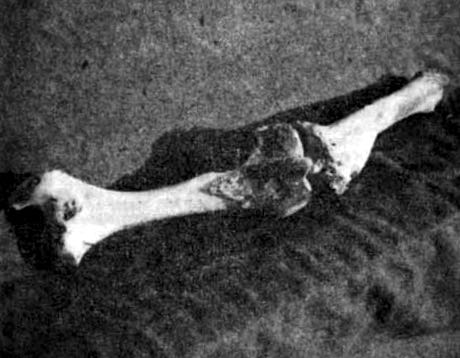
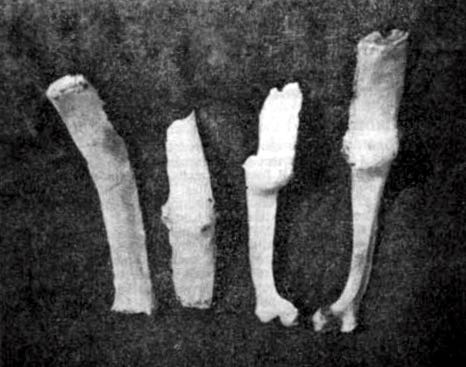
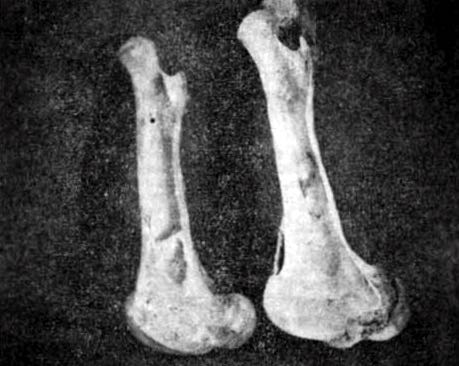
Erosion of articular surfaces of hip and stifle joints, with periarticular exostoses, have been noted. In addition, exostoses on ribs, indicating previous fracture, have been noted in most cases. In some cases no evidence of an osteoporotic condition has been noted, but this has been seen in others. Histological examination of affected bones has not been completed.
ANALYSIS OF BORE WATER
Expressed as grains per gallon, the following figures were obtained:— Borehead — Calcium 3.4. Magnesium 1.0. End of drain (3 miles from borehead) — Calcium 2.0; Magnesium 1.0.
BIOCHEMICAL ANALYSIS
25/10/57 (Dry feed) Serum calcium 9.5 mgm.%, magnesium 1.9 mgm.%; blood phosphorus 2.6 - 4.4 mgm. (9 ex 10 in marginal or deficiency range).
08/01/58 (Dry feed) Blood phosphorus 2.4 - 4.8 mgm.% (5 ex 7 in marginal or deficiency range).
29/10/59 (Feed just haying off) Serum calcium 9.6 - 10.9 mgm.%; magnesium 0.7 - 2.1 mgm.%; blood phosphorus 1.5 - 4.7 (5 ex 8 in marginal or deficiency range).
DISCUSSION
Low blood phosphorus was noted in both dry and lactating animals and in view of the low levels noted at three samplings, together with age incidence, it is evident that a marginal hypophosphorosis applies in this case. In aged, high producing cows a similar condition is reported to occur as the result of a slight phosphorus imbalance extending over a lifetime. Since beef cattle are involved in this case, some factor in the local environment may apply. Result of histological examination of affected bones is awaited with interest.