
ARCHIVE FILE
See the original document
INSTITUTE OF INSPECTORS OF STOCK OF N.S.W. YEAR BOOK.
Chronic Copper Poisoning and Heliotrope Poisoning of Sheep
J.C. KEAST. B.V.Sc., Principal Veterinary Research Officer, Glenfield.
It has only in recent years that investigational work carried out under the direction of the Toxaemic Jaundice Committee has enabled chronic copper poisoning to be defined as a distinct condition in south-eastern Australia. This work has separated clearly the so-called Toxaemic Jaundice or Enzootic Jaundice in sheep into the two separate, though at times related, conditions of heliotrope poisoning and chronic copper poisoning.
Chronic copper poisoning is characterised by the development in the animal with a high copper status, of icterus of haemolytic origin. The copper storage is acquired slowly, usually over a period of at least some months, but the destruction of red cells and the haemolytic jaundice develop rapidly following the mobilisation of copper in the blood stream.
CONDITIONS UNDER WHICH CHRONIC COPPER POISONING OCCURS:
The disease has occurred under four separate sets of conditions in this State.
- When sheep have access to plants growing on soils with an abnormally high copper content and where plants are contaminated with dust from old copper mines. Some of the outbreaks in the Central Western Slopes are due to the high copper intake. One interesting outbreak in the Dubbo district a few vears ago resulted in the death of ewes and their five-months-old lambs which had access to pasture growing near copper mines. Analysis of samples of Crowfoot (Erodium sp.) from the paddock revealed copper in excess of 100 parts per million, so that even the young lambs had the opportunity to acquire a sufficiently high copper status and die of copper poisoning within two or three months.
- A sufficient copper intake to produce poisoning has followed grazing on pasture directly contaminated with copper sulphate when the salt has been indiscriminately used for the control of the fluke snail or for footrot. The erection of permanent footbaths of bluestone surrounding salt troughs is a particularly dangerous practice.
- Chronic copper poisoning frequently develops as a terminal event in some cases of heliotrope poisoning and probably also following liver damage caused by ingestion of other plants, such as Echium and Senecio.
- The most serious and important outbreaks occur when susceptible sheep graze subterranean clover pastures growing in acid soils under favourable seasonal conditions.
OCCURRENCE OE THE DISEASE IN NEW SOUTH WALES:
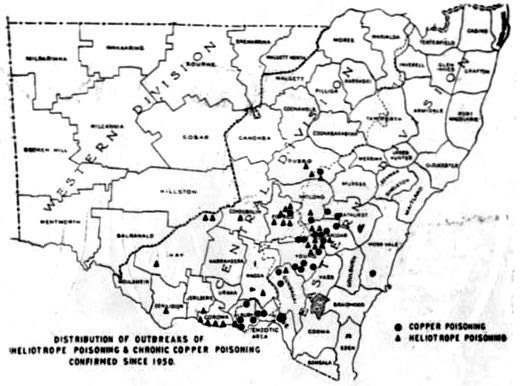
Although chronic copper poisoning has been defined only as a separate entity in recent years, there is little doubt that outbreaks of Toxaemic Jaundice reported from the Forbes and Carcoar Districts in the late 1920's were due to this condition. Since 1950 the disease has been confirmed in flocks on many properties in the Central Western Plains and South Western Slopes; involving the Pastures Protection Districts of Forbes, Carcoar, Molong, Young, Bathurst and Dubbo. Many of these outbreaks have occurred on natural pastures while others have followed grazing on subterranean clover. In the Southern Tablelands and Riverina the disease has appeared only following the establishment of clover pastures in the late 1930's, and in some of these areas the disease is now enzootic.
The geographical distribution of outbreaks which have occurred since 1950 and which have been confirmed as either heliotrope poisoning or chronic copper poisoning are illustrated in the accompanying map:—
It should be kept in mind, though, that apart from those defined, there are other extensive areas, such as certain Western Riverina Districts, in which losses are so common as to be accepted by sheep-owners as more or less normal. The natural consequence is that outbreaks in these areas are not reported unless deaths become more than usually heavy.
BREED AND AGE INCIDENCE:
The disease is most common in British breeds and their crosses with the Merino. Merino sheep are not grazed extensively in the areas or on the pastures where the disease occurs, but no doubt they have a higher resistance to copper poisoning; the disease having been eliminated from properties by changing from fat lamb production and restocking with Merino sheep.
Despite reports of copper poisoning in lambs and hoggets, adult sheep are affected more commonly. Rams, and wethers if kept for two years, appear to be just as susceptible as ewes.
COPPER POISONING ON SUB. CLOVER PASTURES:
In the enzootic areas such as the Southern Tablelands, odd cases of cooper poisoning occur each year, but outbreaks are most severe where heavy late summer and autumn rains favour the early germination and continued luxuriant growth of the plant. Such favourable conditions occurred in this area in 1939, 1946 and 1947 and few improved properties running crossbred sheep escaped losses in these years.
Sub. clover, like other legumes, normally contains 10-20 p.p.m. of copper compared with say, 5-10 p.p.m. in grasses. Under favourable conditions on these acid soils the early clover growth has a very low molybdenum content and it seems likely that the copper-molybdenum ratio is a most important factor in the liver copper storage of animals on these grazing conditions. In field trials where such pastures have been top-dressed with Molybdenum at the rate of 1 lb per acre, the molybdenum content of the clover has been increased, with a resultant marked reduction of the copper status of sheep grazing thereon. Since the commencement of these trials, however, seasonal conditions favourable to the development of the disease have not occurred, so that the value of such top-dressing in minimising losses has not been determined yet under practical conditions. The recent demonstration of the importantance played by sulphates in allowing molybdenum to control copper storage has not been investigated on susceptible sub clover pastures. Trials are in progress, however, and the practical application of laboratory findings must wait for the occurrence of natural outbreaks of the disease.
Losses from copper poisoning on clover pastures have been reduced on a number of properties by—
- introduction and encouragement of grasses in sub. clover pastures.
- withholding sheep from the early luxurious clover growth until lambing in late June and early July.
- the use of molybdenum licks.
However, without any suitable controls it has not been possible to determine which of these three methods is of most value.
Increase in the consumption of molybdenum by the sheep is obtained more effectively by the top-dressing of the pastures, and the application of one (1) pound molybdenum per acre has increased the Mo. content of sub. clover from 0.4 to 10 p.p.m.
Present field trials on properties in the enzootic area include the use of Mo. as a top-dressing, together with sulphate made available in the form of a lick. It is not only too early, but also dangerous for any recommendations to be made until such trials are completed, as the possibility of producing a copper deficiency must be kept in mind.
HELIOTROPE POISONING
Heliotrope poisonmg of sheep has been described quite well in Leaflet No. 61 of the N.S.W. Department of Agriculture and rather than repeat the information contained therein, it is felt that these remarks should he confined to more recent knowledge of the disease; as well as to some aspects which have not been emphasised sufficiently in the leaflet.
Heliotrophum europaeum continues to spread into new areas each year and at present grows over much of the Central West, Southern Riverina and south-western New South Wales. In favourable seasons the plant now thrives over most of the Forbes, Carcoar and Dubbo Districts; with extensive areas in the Molong, Canonba and Condobolin Districts also infested. In the southern portion of the State, where the plant has for long been called Yarrawonga Weed and Barooga Weed, it grows over considerable areas of the Corowa, Urana and Deniliquin Districts, and in recent sears has spread extensively in the Albury, Wagga, Jerilderie, Narrandera and Gundagai Districts.
As the spread of the plant continues one can expect losses from heliotrope poisoning to increase each year and this trend has been observed in the last few years; since this disease has been recognised as distinct entity in the "toxaemic jaundice complex." It is apparent to Inspectors of Stock that the incidence of most diseases cannot be assessed accurately by the number of outbreaks reported to and investigated by the authorities, as so many graziers are reluctant to disclose much information regarding stock losses. Although only fifteen to twenty-five outbreaks of copper poisoning and heliotrope poisoning are investigated and confirmed by laboratory examination annually, it is interesting to note that our active Inspector at Forbes has information on the occurrence of 17 outbreaks of heliotrope poisoning alone in his District over the last couple of years. Similar losses must and do occur in favourable seasons in the Murray Valley, but the services of the Department are never enlisted. Outbreaks of heliotrope poisoning which have been confirmed since 1950 are illustrated also in the map.
ALKALOIDS RESPONSIBLE FOR TOXICITY OF HELIOTROPE
A considerable amount of work has been carried out on the extraction of the toxic principle from the plant and no less than seven alkaloids, together with the N-oxides have been isolated. The two main alkaloids appear to be heliotrine and lasiocarpine, while the proportion of these to their N-oxides varies from time to time; possible according to climatic conditions, soil types and the various tages of growth of the plant. Lasiocarpine can produce acute toxic effects of mainly haemmorhagic extravasation, while helliotrine in small doses produces the typical chronic lesions of heliotrope hepatitis. Work on the alkaloids is being continued.
The course of the disease
Although the primary lesion in Heliotrope poisoning is usually chronic hepatitis, the final termination or course of the disease may be acute or chronic, and this has been of observed in practically all mortalities where continued observations have been possible.
Most of the deaths in the early stages of and outbreak are of an acute type; many animals simply being found dead without previous signs of ill-health being observed. Closer observation will reveal many such cases to be sick for a period of 24 to 36 hours. At autopsy many of these acute types may show very little, if any, clinical jaundice. The kidneys appear normal but the liver is usually orange or khaki in colour. Small haemorrhages may be present on pleura, pericardium and epicardium. Lesions of enteritis are not infrequently present and at times may be sufficiently severe to result in the presence of free blood in the lumen of the gut. Rapid post-mortem changes and an enlarged soft spleens have resulted in at least three of these acute outbreaks being initially and tentatively diagnosed as Anthrax; particularly as only a single carcass was available for examination on the day of investigation.
Cases also are seen in which the disease runs a less acute course and animals may be observed sick for three to five days. Jaundice is seen in most of these cases and often is intense.
The chronic cases are encountered mostly when losses have eased and in these the sheep lose weight rapidly and may exist for weeks or even months in an emaciated state. The chronic case usually shows only a mild jaundice but autopsy invariably reveals a small, shrunken fibrosed liver.
The development of a haemolytic jaundice
Usually only a small but variable percentage of cases develop a terminal haemoglobinuria. This varies even from year to year on the same property. In some of the earliest observations in outbreaks in the Deniliquin district the proportion of cases showing haemoglobinuria was so high that this finding was considered characteristic of the disease. Later, at the Barooga Field Station observations revealed only two of eighty successive cases to develop a terminal haemolytic crisis. There are three reasons why heliotrope consumption favours the development of the haemolytic crisis of copper poisoning. Firstly, the plant contains up to 20 p.p.m, copper with an average of about 12 p.p.m.; compared with annual and perennial grasses with an average of about 7 p.p.m. By consuming heliotrope over some months the copper status of sheep naturally will increase. Secondly, the hepatic lesions cause the liver to become small, shrunken and fibrosed with a resulting increase in the actual concentration of copper in the liver cells. Thirdly, exposure to heliotrope does actually increase the affinity of the liver cell to copper. This last reason explains the danger which may follow the transfer of susceptible sheep from heliotrope expusure to lush sub. clover pastures.
THE DELAYED EFFECT OF HELIOTROPE GRAZING
The extended interval between the period of heliotrope grazing and the commencement of serious losses was one of the major reasons for the delayed incrimination of the poisonous properties of the plant in stock losses. The plant grows profusely following summer rains from mid-November to March and remains more or less green until frosts appear. Losses in the Murray Valley usually commence about June and continue till August or even November, so that deaths from heliotrope poisoning have been delayed for as long as twelve months after removal of sheep from the plant.
PREVENTION OF HELIOTROPE POISONING
1. Graziers must realise that the plant is poisonous and the ultimate aim must be to eradicate it from the property.
2. Stock losses must be prevented immediately by denying susceptible sheep access to the plant when it flourishes in favourable seasons. It must be remembered that exposure to the plant for two successive seasons can result in disastrous losses. The practice of cleaning the plant from fallow land by grazing is a popular but very dangerous one.
3. Supplementary feeding to maintain sheep on an even plane of nutrition will reduce losses from heliotrope poisoning.
4. Heliotrope has been eradicated from stubble pastures by the inclusion of Wimmera Rye grass seed with cereal sowings in areas where the rainfall is sufficient for the establishment of the rye.
5. In similarly favourable areas, or where irrigation is available, the establishment of lucerne stands may provide sufficient summer feed to enable heliotrope to be excluded from the sheep's diet.