
ARCHIVE FILE
See the original document
INSTITUTE OF INSPECTORS OF STOCK OF N.S.W. YEAR BOOK.
OUR INSTITUTE
E. A. LUCAS, Inspector of Stock, Maitland. (Official Historian).
Almost completely unrecognisable by comparison with his earliest predecessor, the present-day Inspector of Stock employed under the Pastures Protection Act originated almost 100 years ago, following recognition of the very great harm which Sheep Scab well might do to the flocks in this State. A particularly successful campaign, in the circumstances, resulted in the wiping out of this disease by 1868; in which year Sheep Districts were proclaimed under the Diseases in Sheep Act. This Act was superseded in 1890 by the Pastures and Stock Protection Act, which in turn gave way to another Act under the same title in 1898; while, in 1902, the latter was succeeded by the Pastures Protection Act — the progenitor, though similar almost in name only, of the Pastures Protection Act, 1934-43. Under the Disease's in Sheep Act, 1866, provision was made for the election of Sheep Directors annually. The Act of 1880 apparently maintained the status quo so far as the Districts and Sheep Directors were concerned, but following the arrival of the P.P. Act, 1902, the distinguishing names of the present Boards and Districts were gazetted on 11th February, 1903.
The Diseases in Sheep Act, 1866, provided for the appointment of Inspectors of Sheep by the Governor, on the nomination of Sheep Directors; such Directors or the Chief Inspector having power to suspend an Inspector, with the Minister retaining the power to dismiss or remove. By the Pastures and Stock Protection Act, 1880, provision was made for Inspectors of Sheep to be Inspectors under that Act, and subject to the direction of the Minister.
It appears that by Regulation dated 6th February, 1888, the first provision was made for the appointment of Inspectors by examination, and the first available record of such examination is the 23rd September, 1895. From 3rd October, 1904, it was decided to grant First and Second Class certificates, according to the proficiency shown at examination, and apparently this method of selection was followed until 1921, when University graduates in Veterinary Science first were granted the Stock Inspector's certificate. It perhaps is interesting to note that of the total number of men granted the certificate, only 138 have received appointment as Inspectors, to an approximate average of 60 Districts, since the inauguration of that certificate in 1888.
In the early years of the writer's recollection as an Inspector the salary range was from about £300 to a maximum in the vicinity of £400. Even as late as 1916 the salary range was £325 — £350 — £360 — £375 — to £400 per annum. Salaries, as at present, were paid by the Boards, but they were not then, of course, fixed by the Arbitration Court; and consequently the remuneration received depended on many factors beyond the control of the Inspector, and in many cases had little, if any, relationship to efficiency and or the amount of work done. Some Boards, in fact, paid a variable bonus to their Inspectors each year, but (and this was the greatest pit-fall) there was not any statutory allowance for equipment or travelling; so that the more the Inspector worked and travelled the worse off he was financially. Any specimens for examination were forwarded to the old Head Office of the Stock and Brands Branch, at the never-to-be-forgotten 56 Bridge Street, at the expense of the Inspector, if he were unable to scrounge the expenses out of his Board. It well may be believed that the predominance of "cause unknown" as a diagnosis was due almost entirely to the complete lack of preservative and the unsuitability of treacle tins,etc., as containers. Either the tins exploded before examination or the contents were in such a state that disposal became the prime object of the investigator.
The means of transport, though normal (and even fashionable) in those days, would be looked upon now as a sheer hindrance to efficient working. Horse-drawn vehicles of various types, which depended largely on the class of country in the District. In the coastal or more closely settled areas a sulky with one horse was popular, an outrigger being attached for any heavy going; but in the plain country a pole sulky or Abbot buggy was selected usually. In the larger Districts, at least, it was necessary to keep up to six or eight harness horses, often with one or two hacks in addition, and even a pack-horse in odd cases. For instance, Frank Madden at Tibooburra preferred a light Abbot buggy and pair, and he maintained three pairs of harness horses, two hacks and a pack. Frank Hildred at Ivanhoe always used a pole sulky and a pair of good, nuggety, 14 hands ponies, of which he kept four pairs, besides a hack. Wherever possible the horses were worked in pairs off the grass; this being quite practicable, of course, so long as frequent changes were made. Nevertheless, the feed bill was often a big item and, naturally, provision had to be made for the frequent camping away from home which the Inspector was obliged to do. All this equipment was owned by the Inspector, and not provided by the Boards.
Naturally enough in all the circumstances, even though relations in the majority of Districts were quite harmonious, there was considerable dissatisfaction—expressed individually and in contacts between neighbouring Inspectors. Many, though having ample practical experience, felt the lack of knowledge and experience of Departmental methods, and several were very much alive to the necessity for having the conditions of appointment defined much more clearly. In this latter regard, one of the best known Inspectors, in his day, first suffered a lock-out; and then carried on for a considerable period as an opposition show to his Board, and without salary, until the position was ironed out by Head Office. The method of payment of salaries created difficulties, of course, but the lack of equipment and of travelling and equipment allowances was the greatest trouble; closely followed by the haphazard nature of leave entitlements, if any, and the absence of any superannuation or pension rights.
The need for a general conference of Inspectors obviously was a pressing one, but it was not until the writer, with the assistance of his father, who was in Sydney at the time, found on contacting the Department that the then Chief Inspector of Stock (Mr. S. T. D. Symons) was prepared to assist in every way in bringing about the desired conference; though the idea then was to include all P.P. Board Officers. By 1917 a Provisional Committee of the "Institute of P.P. Board Officials of N.S.W." had come into being. This committee consisted of E. A. Lucas (Canonba), F. F. Forster (The Hume), C. J. Woollett (Tamworth), D. F. W. Batten (Bourke), C. R. Brett (Bathurst), E. A. Hamilton (Moss Vale) and G. C. Shaw (Secretary, Canonba Board). The Provisional Secretary was E. A. Bluett, who already had had considerable experience is a somewhat similar field in association with Local Government officers. Towards the end of that year the total membership had reached 31 (22 Inspectors of Stock, 8 Secretaries and one Rabbit Inspector), and it had been decided to hold the first Annual Conference as early as possible in 1918.
Eventually the inaugural meeting, which preceded the first conference, was held at the King's Hall, Hunter Street, on Monday, 25th March, 1918. The total membership then had risen to 87; of whom 52 (37 Inspectors of Stock, 11 Secretaries and 4 Rabbit Inspectors) attended this Inaugural meeting. A draft constitution had been drawn up by the Provisional Committee, and this was accepted with very few amendments, the chief of which was the decision to designate the association the "Institute of Stock Inspectors and P.P. Board Officials"; it being contended that Inspectors of Stock were not legally P. P. Board Officials. The annual subscription was fixed at £2/2/- for Inspectors of Stock; and £1/1/- for Secretaries, Rabbit Inspectors and Associate Members. E. C. Bluett was appointed Secretary at a salary of £78 p.a., as from 17th October, 1917.
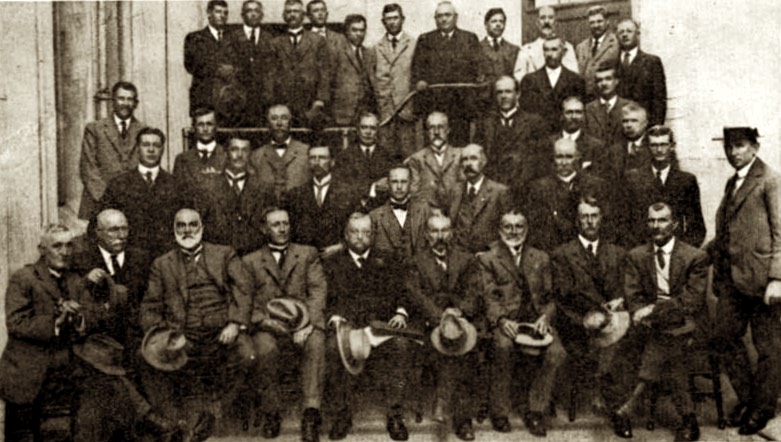
A photograph of the majority of those who attended our first conference has been made available through the courtesy of C. J. Woollett, and is reproduced in this issue. Any faults in reproduction no doubt will be overlooked in view of the age of the original; and although the names of all those appearing could not be ascertained, the following will be noted with interest:— Front Row: R. W. Dawson (2nd from left — first President), F. C. Palmer (3rd from left), C. R. Brett, S. T. D. Symons (Chief Inspector or Stock), D. F. W. Hatten (7th from left), — Bucknell (9th) and E. C. Bluett, Secretary (standing). Second Row: W. J. Smith (left), S. Edwards, A. Hessin, F. Whitehouse, B.V.Sc. (Head Office). C. White (2nd from right), E. A. Lucas (right). Third Row: F. Whyte (left), C. J. Woollett, — Freeman (4th from left), E. Reuss (8th), J. Faulkner, H. Pillinger (behind Mr. Faulkner), F. W. Adams. Back Row: H. Copeland (left), F. J. Madden, W. L. Rees, F. F. Forster, M T. Little, H. M. Bloomfield. A. H. Nevell, E. A. Hamilton, E. Kearney, C. Brooks and C. 0. Furness.
So the first Conference got off to a very good start, but it soon became obvious that the interests of other P.P. Board Officers were so different from those of Inspectors of Stock that one Institute would have great difficulty in meeting the needs of all. As a result, the Secretaries and Rabbit Inspectors dropped out before the date of the Second Annual Conference, and the "Institute of Stock Inspectors of N.S.W." came into being.
The first election of officers was held on 27th March, 1918; when R. W. Dawson (Goulburn) became the first President, with C. Brookes (Scone) and C. R. Brett (Bathurst) as Vice-Presidents. A Council of 10 members was elected, and in this body, together with the President, Vice-Presidents and the Honorary Treasurer, the government of the Institute was vested. It was resolved that "the Council may meet once a quarter (if practicable) and at such other times as may be found expedient."
Perhaps the value of the Annual Conference, and the feelings it aroused in members, may be exemplified best by quoting E. A. Hamilton, one of the first and most active members, who became President in 1920 and held that office until 1925 — "Apart from our work on our terms of employment, the Annual Conference had a tremendous influence on us. We never had been together before and enjoyed thoroughly the get-together part of it. The Department, too, did its best for us—the clerical staff straightened out many difficulties, and the work of the Veterinary section appealed to us, perhaps most of all, as it gave us an opportunity to gain some knowledge for which we fairly thirsted. I felt, too, that we were very helpful to the Department in bringing our field experiences under discussion." In point of fact, the Conference programme has been arranged each year to meet the needs so aptly expressed and though improving in detail has varied little in the general set-up since 1920. Apart from the lapse during the very dark days of 1941 and 1942. Conference has been held successfully each year since its inception, and although there was a period when attendances were not up to expectations, with the general revival of payment of certain expenses by the boards (to whom the benefits of conference must accrue) recent years have seen a vast improvement in this respect. For many years the present C.D.A.I. (Mr. Max Henry) has been one of our strongest supporters, while Departmental Officers, both at Head Office and at Glenfield, have been ever ready to assist in making the Conference programmes successful.
During the first two years of the life of the Institute, members received substantial increases in salary, while from 1st July, 1918, equipment allowance was paid separately at the rate of £100 per annum, though in a few of the larger Districts £150 p.a. was paid. By reason of this arrangement, however, the salaries were reduced, mainly by an amount of £50 per annum. So far so good, but many members felt that a more stable arrangement was warranted. The proposal to form a Union had been mooted at the first Conference but it was at that stage a very contentious item. It was contended by some that the formation of such a body would lower the prestige of the Institute and upset the harmonious relations existing in the main between Inspectors and the Department. Persistence wore down the objectors to some extent between, and at, the following two conferences, and on 29th March, 1921, the Union called "The Institute of Inspectors of Stock of N.S.W." was registered under the Trades Union Act, 1881. The first signatories to the rules of the Union were E. A. Hamilton, R. W. Dawson, C. R. Brett, F. H. Whyte, W. J. Smith, D. MacPherson and C. W. Dargin. After registration of the Union the Institute obtained two representatives on a Conciliation Committee, which included also two representatives from the P.P. Boards' Council of Advice, and met under an independent Chairman.
In some measure to appease those who opposed the idea of a Union, and also with the idea of keeping business and scientific objects apart, the original Institute was kept in being; and continued to thrive side by side with the Union until 1944. In that year it was decided finally that one organisation not only would meet all requirements, but would obviate quite a lot of book-keeping and general secretarial work. The rules of the two bodies were revised and amalgamated, and the Union remained as the sole organisation; under its original title.
Following the registration of the Union the first award was gazetted on 14th July, 1922. Commencing in 1922 the amount fixed for car allowance, when the vehicle was the Inspector's own property, was at the rate of £200 p.a., though by 1924 9d. per mile was being paid in some cases, while the £200 p.a. continued in others. Needless to say, however, that high mileage rate could not survive the more exact system of costing soon to be introduced. Nevertheless, renewals of the first Award did add various improvements; so much so that the 1921 Award was accepted generally as a very satisfactory improvement. Travelling allowances were reasonable, while equipment expenses were catered for down to specific sums for garaging and cleaning of cars; which had come into general use by 1922 to replace the however much more picturesque buggy and pair (or what have you) with which the earlier men laboured to cover their Districts even comparatively adequately. The question of holding the 1927 Award in 1930, perhaps the depth of the last "depression," naturally was a tremendous task. That it was held, or practically so, reflects great credit on the Executive of the day, led by the untiring energy of the then President. C. J. Woollett, who sought data from every Inspector and finally had the cases submitted by five (representing all classifications of Districts) placed personally before the Conciliation Committee. The times were really bad, though, and subsequently the Institute accepted voluntarily a reduction of 8½% in all salaries; this reduction remaining in force until the expiration of the 1930 Award.
With the restoration of the "depression" reduction, salaries remained practically stationary, except for basic wage variations, until a move was made early in 1943 to obtain the general increase which most members thought fully merited and long overdue. This meant much hard work for the Executive of that year (comprising, as they did, the two Institute members, and the alternate member, on the Conciliation Committee), but eventually their efforts were rewarded when an appreciable, especially in the higher class Districts, general increase was agreed to early in 1944 and made retrospective to 1st December, 1943. One of the main and earliest, of the many achievements of the Institute was associated with the enactment of the Veterinary Surgeons Act, 1923. During the drafting of this Bill the Executive explored many avenues in an endeavour to ensure that members of the Institute would be able to register under the Act when it became law. Due mainly to the efforts of E. A. Hamilton, not only was the opportunity to register granted, but the Institute was given a representative on the Veterinary Surgeons' Board. This position was filled most ably by E. A. Hamilton (then President) until his resignation. Our present representative on the Board is F. Mildred, who was appointed as from 1st January, 1942.
Superannuation in one form or another was a major objective. In fact, it was one of the principal factors which brought the Institute into being, and although the subject was not submitted to the first Conference in anything like a concrete form, it certainly was discussed widely among the members. A definite proposal very soon was submitted, and from then on this proposal in all its ramifications was shuttled between the Institute, the Department, the Public Service Board and Cabinet. Whether an Inspector of Stock was or was not a Public Servant was perhaps the chief question in the way of early settlement, though the question of how much and by whom naturally was involved. With finality in sight towards the end of 1937 a spanner was thrown in the works by a ruling given by the Industrial Commission to the effect that Inspectors of Stock were Crown Employees. Merely under a definition in the amended Arbitration Act; but nevertheless sufficient to call a further halt for a further review of the position. Eventually, however, a superannuation scheme, based on insurance, came into operation on 9th December, 1940. As is known, halt of the premium is paid by the Inspector, one quarter by the P.P. Board and the remaining quarter by the Department.
As indicated earlier, the government of the Institute was in the hands of its chief officers and a Council of ten members. From the inception, however, the President and the Vice-Presidents comprised an Executive, to which the first rules gave the right to exercise any power vested in the Council. For many years an endeavour was made to govern by Council, though the difficulties associated with bringing together more or less frequently a body of men scattered over the whole State was far too great. The natural result was that gradually the Executive became, in fact, the actual governing body; though a Council was elected annually until 1944. Later in that year, as stated already, the arduous, if not difficult, job of reviewing, revising and amalgamating the rules of the old Institute and the Union was undertaken by the then Executive. The result was that towards the end of 1944 the present rules were adopted; one of the major changes brought about thereby being the elimination of the Council and the consequent recognition of the Executive as the sole governing body.
The office of the Secretary was held by E. C. Bluett from 17th October, 1917 (the very early days of the Provisional Committee) until he resigned on 31st August, 1938. For the three months following that date the secretarial work was carried out by J. G. Johnston (President) with the assistance of Miss D. Delaney, Albury; until the appointment of C. Foster Powell, the present Secretary, on 11th November, 1938.
This History would not be complete without special reference to the eight members who have served well and faithfully in the office of President since the first Annual Conference nearly 28 years ago:—
| PRESIDENTS. | |
|---|---|
| 1918 — 1920 | R. W. Dawson. |
| 1920 — 1925 | E. A. Hamilton. |
| 1925 — 1927 | J. Faulkner. |
| 1927 — 1929 | F. F. Forster. |
| 1929 — 1936 | C. J. Woollett. |
| 1936 — 1939 | J. G. Johnston. |
| 1939 — 1943 | F. J. Madden. |
| 1943 — | P. Hildred. |
Acknowledgment: The assistance of E. A. Hamilton and C. J. Woollett, both of whom grace our Honour Roll, and of Mr. Reg. Jago of the Department of Agriculture, in supplying valuable material for this History is acknowledged gratefully.
(Note: E. A. Lucas, our Official Historian, may claim with justice the title of "the father of the Institute". He has been associated with it since it was merely an idea in the minds of the early members; and since its inception he has been absent (unavoidably in each case) from two Conferences only, and served continuously as Councillor or Vice-President until he declined nomination in 1945. — Editorial Committee.)