ARCHIVE FILE
See the original document
INSTITUTE OF INSPECTORS OF STOCK OF N.S.W. YEAR BOOK.
HYDROCEPHALUS IN A CALF
A. R. McNiven. Inspector of Stock, Port Macquarie.
Recently the writer was asked to make an examination of a dairy cow which was unable to calve. On arrival at the farm it was learned that the cow had been in labour for rather more than 24 hours, so naturally she was in rather a low state and showed considerable distress.
Examination revealed a well developed hydrocephalus in the foetus and it was found impossible to effect delivery by the normal route. The cow was a very decent dairy type and a good producer, and the owner therefore was advised that the calf might be removed through the flank in an endeavour to save the cow. Before casting the cow for the operation an incision was made in the skin of the calf's head and as much fluid as possible drained off in the hope that perhaps it would be possible to collapse the head and complete delivery in the ordinary way; but when the hand was inserted through the opening it was found that the boney structure of the skull was far too hard to allow of this being done.
The owner was then advised that his cow was in rather a low state for a major operation but that if he cared to take the risk the attempt to get the calf would be made, as it was quite obvious that the cow would die if the calf were not removed. The owner was grateful for any assistance that might be rendered and the animal was cast for the job.
The major portion of the operation was performed by two Veterinarians employed by a well-known company; the job being a very difficult one owing to the failing light and the distressed condition of the cow, but in due time the calf was secured through the horn of the uterus and delivered.
It was found that the calf was fully developed and very well grown, and it was quite apparent that it had lived normally up to the time labour commenced, and probably for some time after that. The hind legs were the first to be picked up and the calf was delivered in this way, though when the head was reached it was found necessary to enlarge the opening in the wall of the uterus. The foetal membranes surrounding the head were putrifying and little hope could be held for the life of the mother.
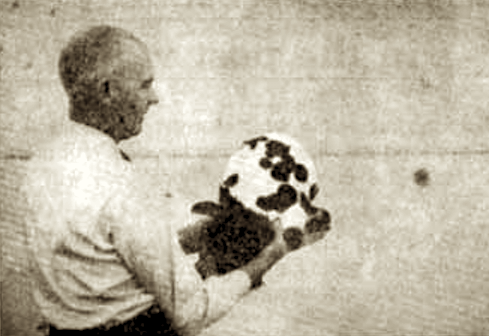
The measurements of the calf's head were as follows:—
| Circumference around forehead | 34½ inches |
| Over the top of the head and around the chin | 36 inches |
| From eye to eye over the top of the head | 24 inches |
The brain cavity held practically two (2) gallons of fluid.
This specimen was unique in our experience and it was thought that it might be of considerable interest to other members of the Institute. The attached photograph illustrates very well the main features associated with this remarkable head; this being the best means of showing the condition.
The patient survived the operation and was left as comfortable as possible in the circumstances, but died during the night. No doubt death was due to shock and the protracted labour.
It is unfortunate that a valuable animal should be lost in such circumstances, and this again emphasises the need for stockowners to call at once upon the veterinary services available to them, instead of depending upon the help which the neighbours can, and will, offer. The very generous nature of many farmers is appreciated. They do not wish to bother the veterinarian, but the State can ill-afford the loss of good dairy cows; and cases such as the above would offer a very much more favourable prognosis if they could be tackled when labour begins, instead of 24 hours later.